PTEN is a tumor suppressor gene that encodes a phosphatase converting the lipid messenger PIP3 back to PIP2 at the cell membrane, thereby restraining the AKT/mTOR signaling pathway that drives cell growth, proliferation, and survival. It is one of the most frequently mutated genes across many types of human cancer, and its loss promotes unchecked cell growth, survival, and genomic instability, partly through impaired DNA repair. Germline loss-of-function variants in PTEN cause Cowden syndrome, an inherited cancer predisposition disorder associated with elevated risk of breast and thyroid cancer.
This variant
This 5′-UTR PTEN variant occurs in a tumor-suppressor gene whose loss can dysregulate AKT/mTOR signaling and cause Cowden syndrome with increased breast and thyroid cancer risk.
Transcript
NM_000314.8
HGVS · transcript:coding
NM_000314.8:c.-638C>T
GRCh38
chr10:87863832 C>T
GRCh37
chr10:89623589 C>T
VUS: PM2 (supporting) is the only met criterion, and no PTEN Expert Panel Version 3.2 combination rule is satisfied.
Classification rationale
PM2VUS
PTEN c.-638C>Tunknown · exon 1
PM2 supporting: the variant's gnomAD v4.1 allele frequency is below the PTEN VCEP rarity threshold.
PM2→VUS
LYFE Sciences is an AI system, and it can make mistakes. Criteria
may be applied incorrectly, sources may be misread, and a confident-looking
classification can still be wrong. Double-check every criterion and
its underlying evidence before relying on any call.
Gene diagram
· NM_000314.8 · variants mapped to exon structure
PTENNM_000314.8
Fetching transcript structure from UCSC…
Exons
—
Transcript span
—
Strand
—
Variants mapped
—
Source
UCSC ncbiRefSeqCurated
All variants in PTEN—click a row to locate it on the plot · use the link column to open its page
Protein
Location
Classification
Link
Applied criteria · 1 applied · 10 assessed
MetEvidence satisfies this criterion.
Not metEvaluated against available evidence; threshold not reached.
Not assessedApplies in principle, but no evidence was found to evaluate it.
N/ADoesn't apply to this variant type.
Applied · 1
Strength Supporting Moderate Strong Very strong
✓
PM2supportingPathogenic
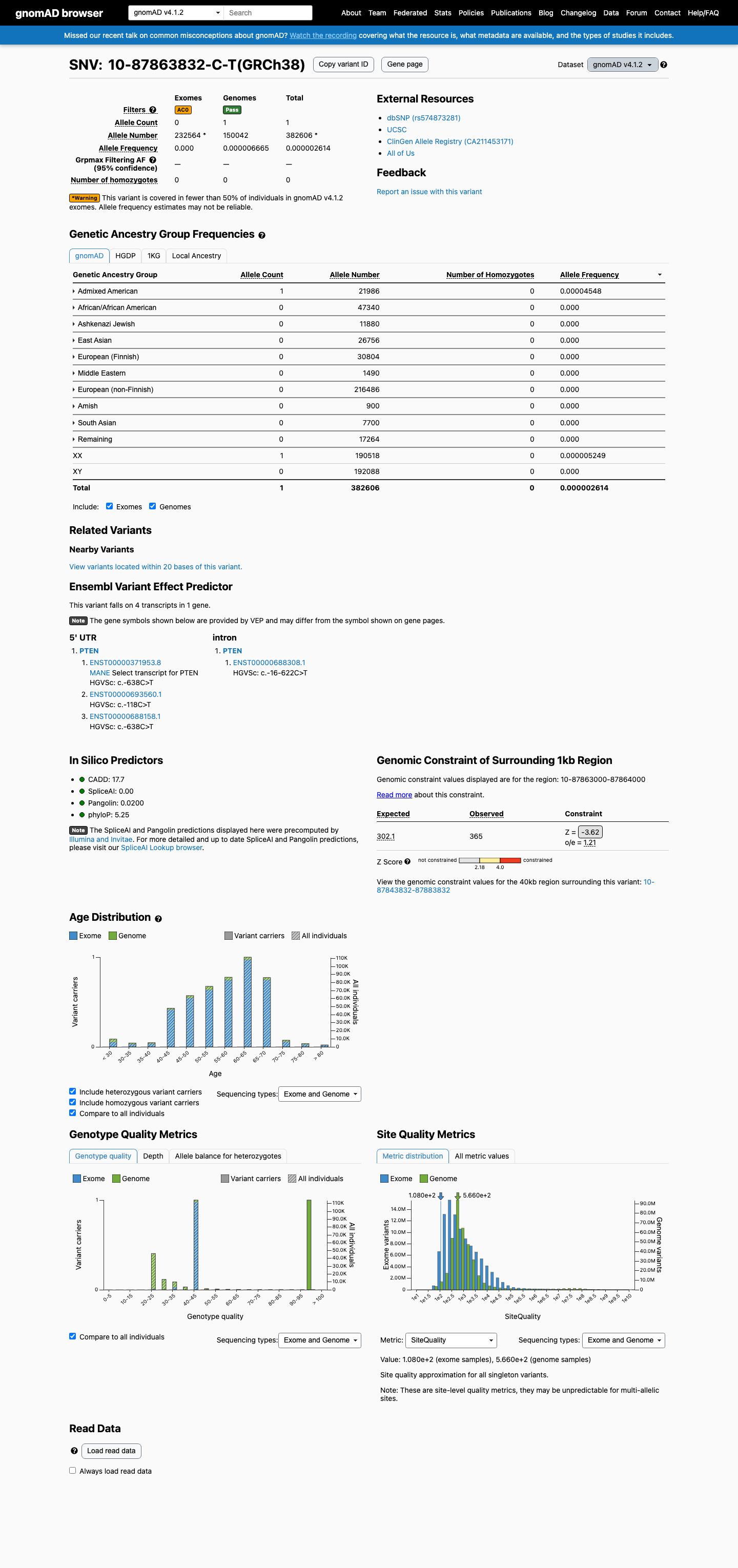
Met at Supporting: gnomAD v4.1 total AF 2.6136547780222995e-06 is below the PTEN PM2 threshold <0.00001.
The PTEN VCEP Version 3.2 specifies PM2 Supporting for allele frequency <0.00001, with a <0.00002 subpopulation requirement when multiple alleles are present.gnomAD v2.1 reports the variant as absent.gnomAD v4.1 reports total AF 2.6136547780222995e-06 from 1/382606 alleles, with 0 homozygotes.
Assessed · not applied
· 3 not met · 7 not assessed
Pathogenic
PS2Not assessed: no proband phenotype, parental testing, or documented de novo observation is available.
PS4Not assessed: no proband specificity score or case-control result is available to compare with the PTEN PS4 thresholds (score ≥1 or odds ratio >2 with required statistical support).
PM6Not assessed: no presumed or proven de novo observation, affected proband, or parental testing is documented.
PP1Not assessed: no affected relatives, segregation results, or meioses are documented against the 3-meiosis minimum.
Benign
BA1Not met: gnomAD v4.1 total AF is 2.6136547780222995e-06 versus the PTEN BA1 filtering-AF threshold >0.00056.
BS1Not met: gnomAD v4.1 total AF is 2.6136547780222995e-06, below the PTEN BS1 Supporting lower threshold 0.0000043.
BS2Not met: gnomAD v4.1 and gnomAD v3.1 non-cancer each report 0 homozygotes for the variant.
BS4Not assessed: no affected family members or family-level non-segregation evidence is documented.
BP2Not assessed: no affected-proband, phase, or cis/trans observation links NM_000314.8:c.-638C>T to another pathogenic or likely pathogenic PTEN variant.
BP5Not assessed: no two qualifying cases with a highly penetrant alternate diagnosis and non-overlapping PTEN history are documented for this variant.
This variant is present in gnomAD v4.1 (AF= 2.61365e-06; MAF= 0.00026%, 1/382606 alleles, homozygotes = 0) and has highest observed frequency in the Admixed American population (AF= 4.54835e-05; MAF= 0.00455%, 1/21986 alleles, homozygotes = 0).
v2.1
Absent from gnomAD v2.1.
🇨🇦 CA
Absent from gnomAD-Canada v1.0.
Allele frequency by ancestry
three datasets · side by side
gnomAD v4.1
0.00026%
· 1 / 382,606
0 hom
Admixed American
1 / 21,986
0.0045%
+ 9 not observed (Remaining individuals, European (Finnish), Amish, East Asian, Middle Eastern, South Asian, Ashkenazi Jewish, African/African American, European (non-Finnish))
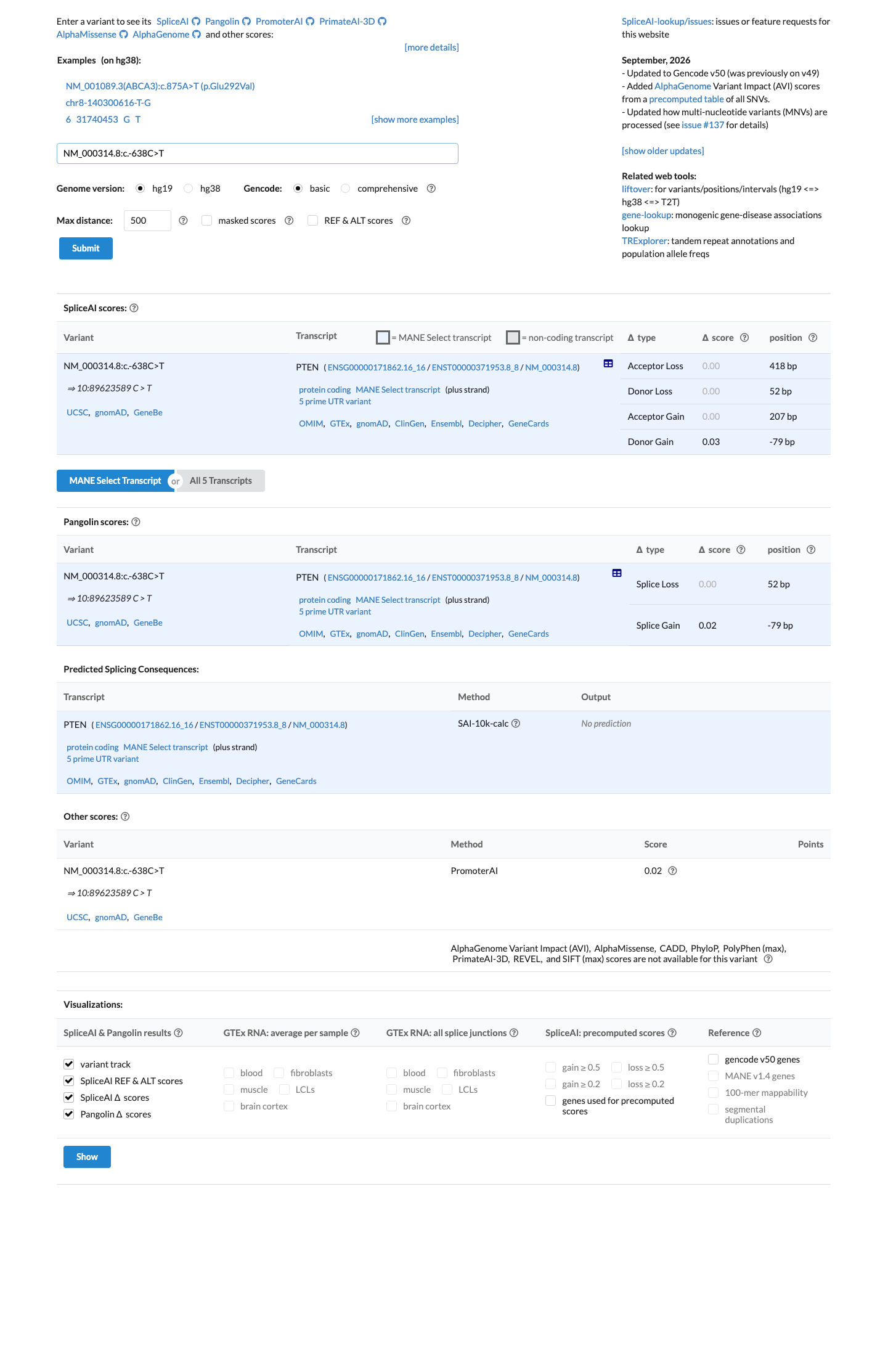
SpliceAI returned NO scores for this variant, so no SpliceAI-based splice prediction is available. This is missing data, NOT evidence of absent splice impact: it must not be used to support BP4 or to argue against PP3/PVS1. Pangolin scores may be present but are not calibrated for PP3/BP4 here.