PTEN is a tumor suppressor gene that encodes a phosphatase converting the lipid messenger PIP3 back to PIP2 at the cell membrane, thereby restraining the AKT/mTOR signaling pathway that drives cell growth, proliferation, and survival. It is one of the most frequently mutated genes across many types of human cancer, and its loss promotes unchecked cell growth, survival, and genomic instability, partly through impaired DNA repair. Germline loss-of-function variants in PTEN cause Cowden syndrome, an inherited cancer predisposition disorder associated with elevated risk of breast and thyroid cancer.
This variant
PTEN is a tumor suppressor whose loss drives unchecked cell growth, and germline loss-of-function variants cause Cowden syndrome with elevated breast and thyroid cancer risk. This variant is predicted to disrupt PTEN splicing and trigger nonsense-mediated decay, eliminating one functional copy of the gene. Its Likely Pathogenic classification indicates it is a probable contributor to PTEN-related cancer predisposition.
BasisUnder the ClinGen PTEN Expert Panel Version 3.2 framework, PVS1 (Very Strong) plus PM2 (Supporting) satisfies Rule20, mapping to Likely Pathogenic.▾
Under the ClinGen PTEN Expert Panel Version 3.2 framework, PVS1 (Very Strong) plus PM2 (Supporting) satisfies Rule20, mapping to Likely Pathogenic.
Classification rationale
PVS1PM2Likely Pathogenic
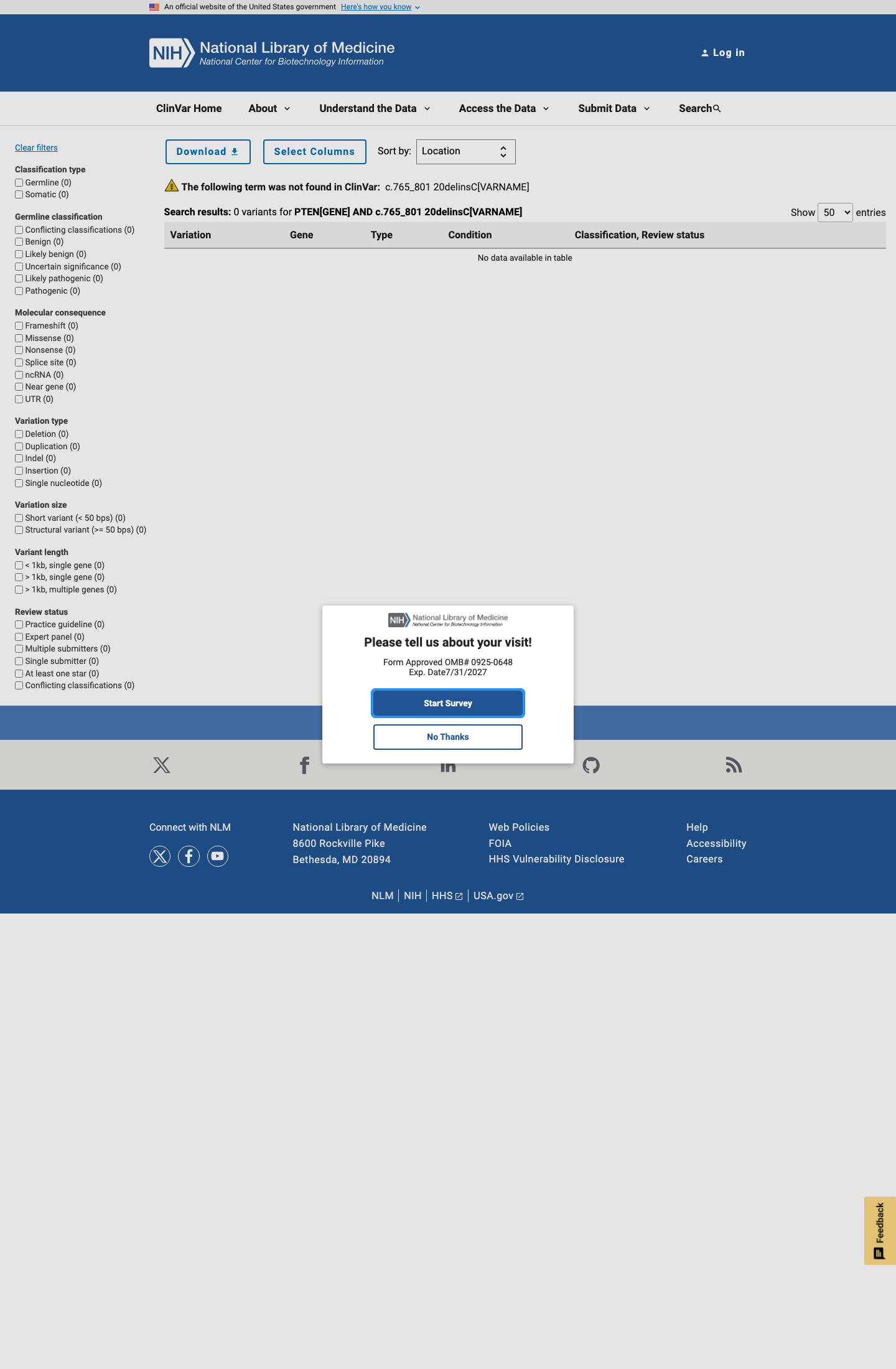
PTEN c.765_801+20delinsCunknown · exon 7-7i
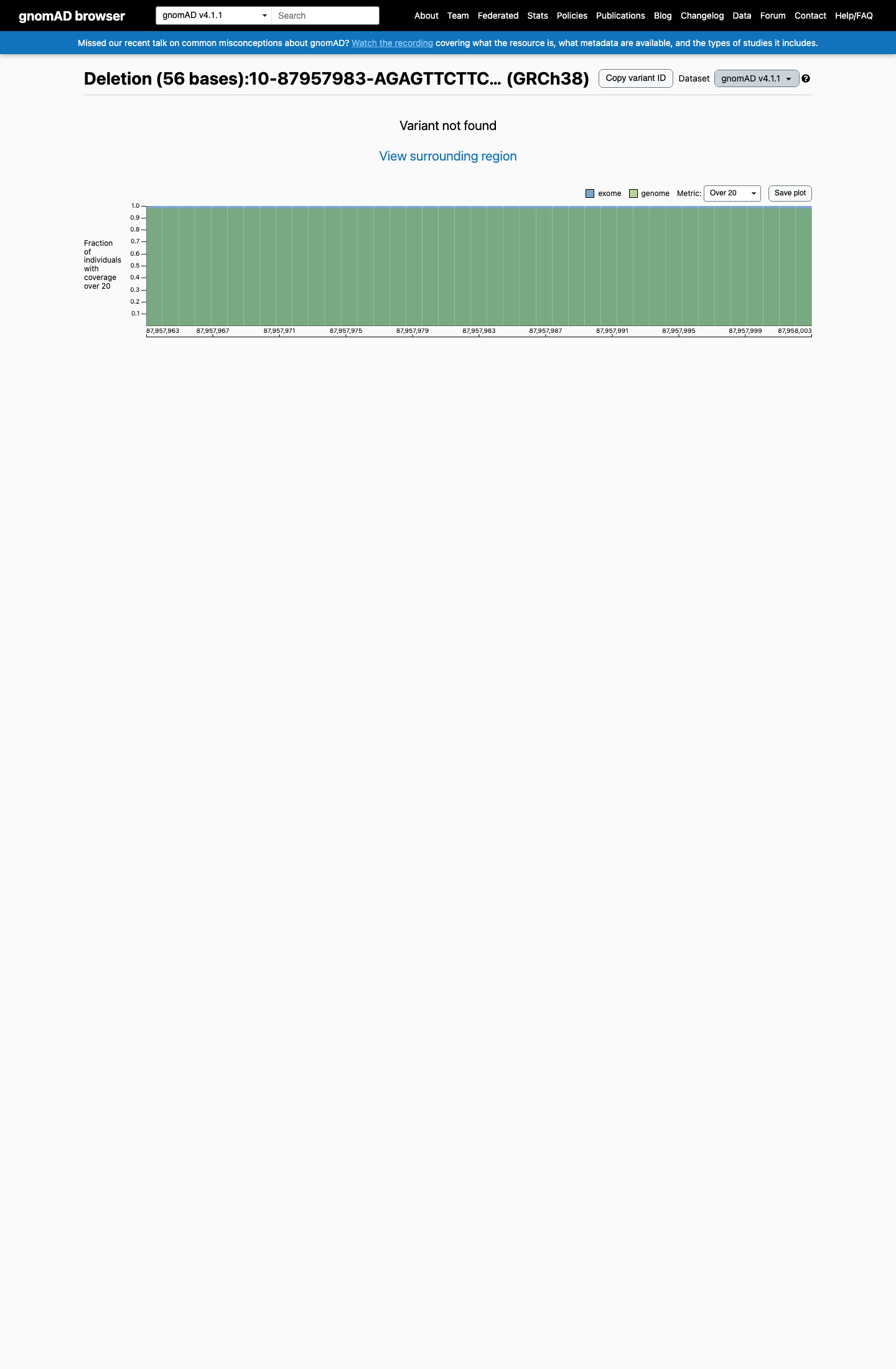
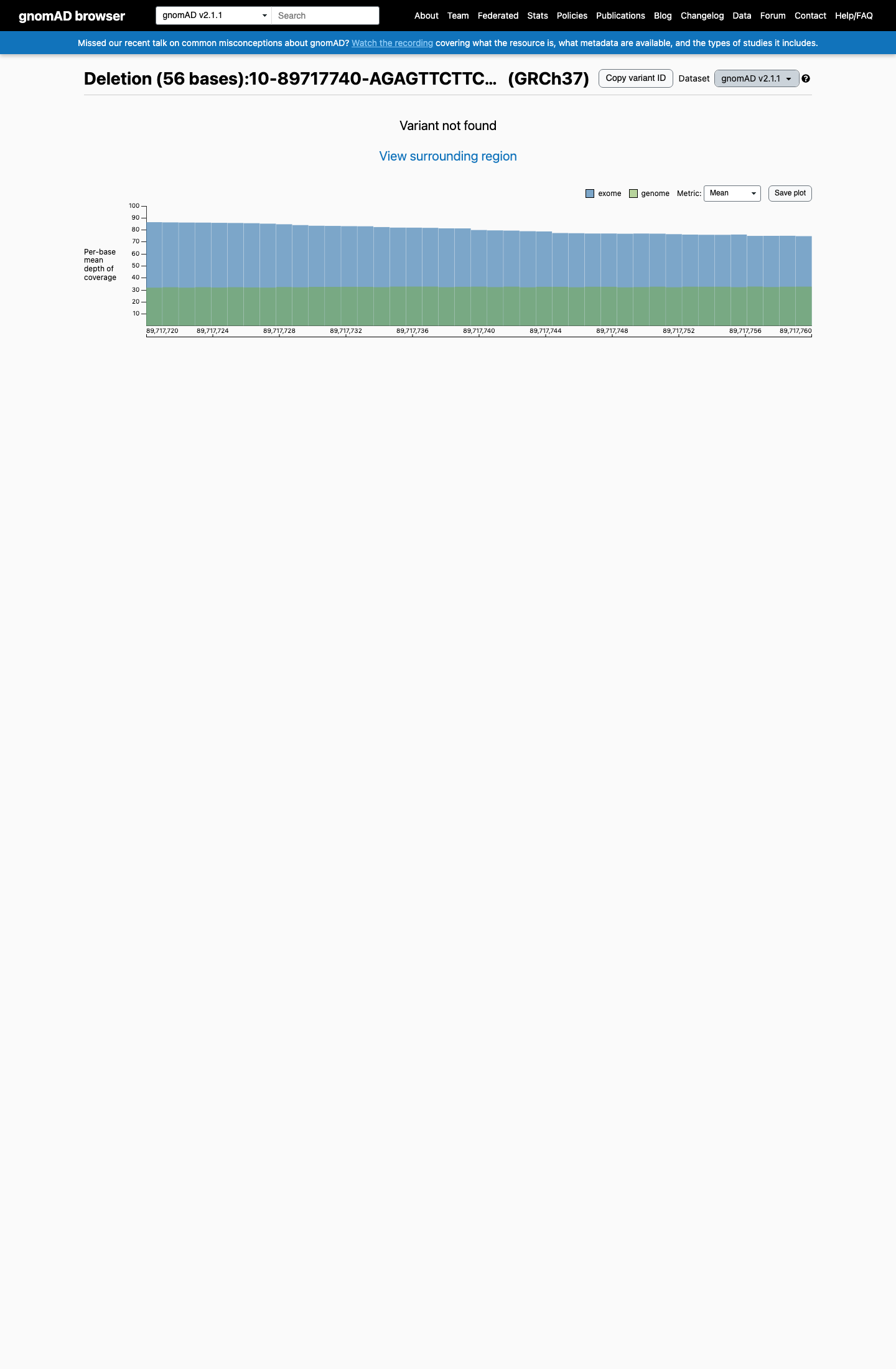
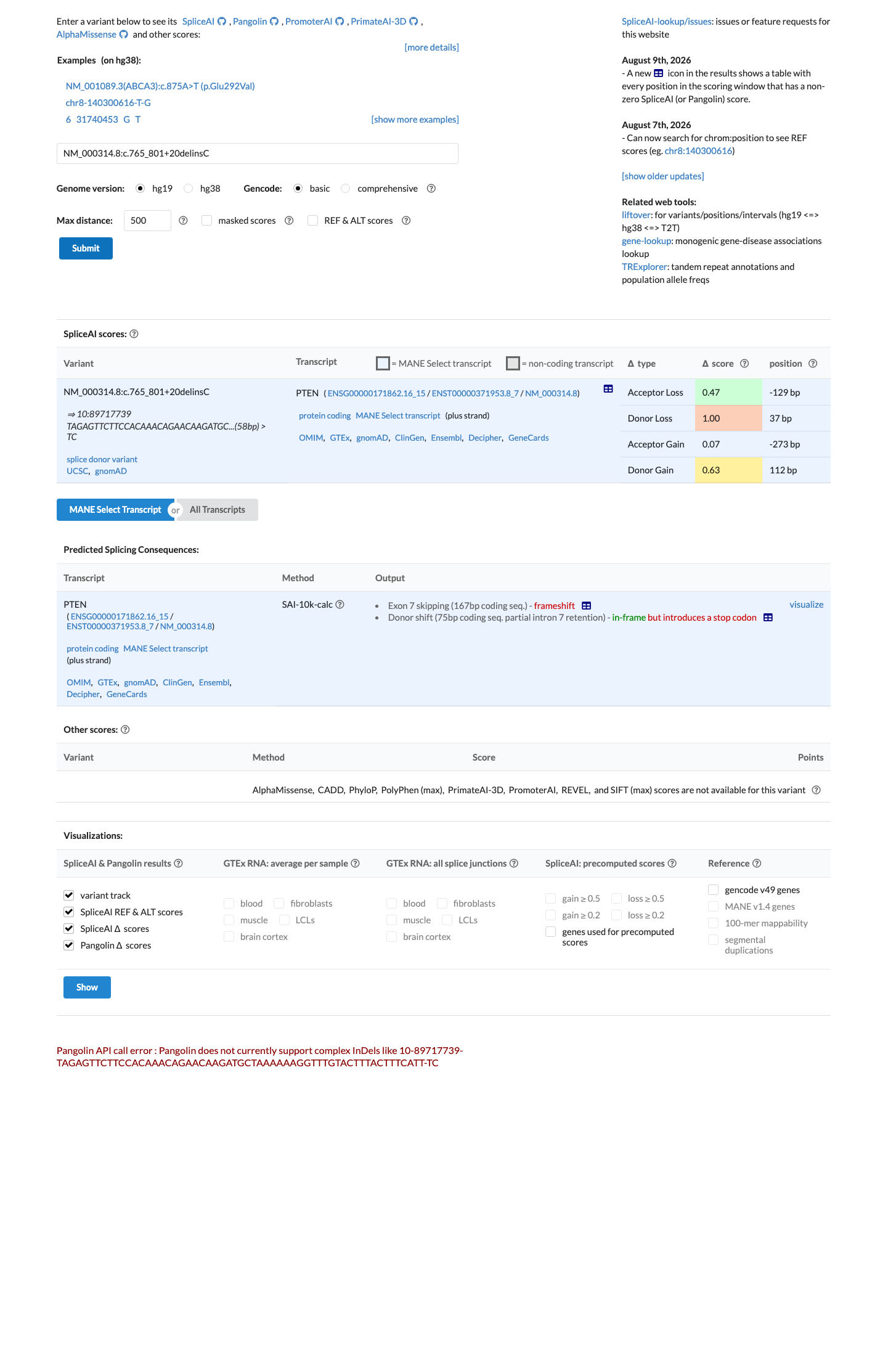
PVS1 (Very Strong): exon 7 deleted out of frame with near-complete donor loss (SpliceAI 0.999), predicted to trigger nonsense-mediated decay. PM2 (Supporting): absent from gnomAD v2.1, v4.1, and gnomAD-Canada v1.0, below the 0.001% allele-frequency threshold. Together, PVS1 plus PM2 satisfies Rule20 under the ClinGen PTEN Expert Panel Version 3.2 framework, yielding a Likely Pathogenic classification.
PVS1 + PM2→Likely Pathogenic
Gene diagram
· NM_000314.8 · variants mapped to exon structure
PTENNM_000314.8
Fetching transcript structure from UCSC…
Exons
—
Transcript span
—
Strand
—
Variants mapped
—
Source
UCSC ncbiRefSeqCurated
All variants in PTEN—click a row to locate it on the plot · use the link column to open its page
Variant ↕
Protein
Location
Classification
Link
Applied criteria · 2 applied · 15 assessed
MetEvidence satisfies this criterion.
Not metEvaluated against available evidence; threshold not reached.
Not assessedApplies in principle, but no evidence was found to evaluate it.
N/ADoesn't apply to this variant type.
Applied · 2
Strength Supporting Moderate Strong Very strong
✓
PVS1very strongreviewPathogenic
Met at very strong: deletes exon 7 out of frame with near-complete donor loss (SpliceAI 0.999), predicted to trigger nonsense-mediated decay.
VariantValidator maps NM_000314.8:c.765_801+20delinsC from exon 7 into intron 7; the deleted interval includes the c.801 donor boundary and extends 20 intronic bases.SpliceAI reports DS_DL 0.999 (donor loss) for this variant.The PTEN Expert Panel decision tree uses NM_000314.8 and assigns PVS1 to a splice disruption at or 5′ of c.1121/p.D375 when aberrant splicing disrupts the reading frame and is predicted to undergo NMD.
Met at supporting: absent from gnomAD v2.1, gnomAD v4.1, and gnomAD-Canada v1.0, below the 0.001% allele-frequency threshold.
The PTEN Expert Panel Version 3.2 specifies PM2 at Supporting strength for variants absent in gnomAD or another large sequenced population, with allele frequency <0.00001 (0.001%); if multiple alleles are present within a subpopulation, that subpopulation frequency must be <0.00002 (0.002%).The case evidence reports the variant as absent from gnomAD v2.1, gnomAD v4.1, and gnomAD-Canada v1.0, with no population or subpopulation allele count detected.
Assessed · not applied
· 4 not met · 11 not assessed
Pathogenic
PS2Not assessed: insufficient evidence was available, with no proband clinical data, parental testing, or de novo observation.
PS3Not assessed: no variant-specific RNA, cellular, or biochemical assay result was available; SpliceAI prediction alone is not functional evidence.
PS4Not assessed: no affected-proband observations, phenotype scores, or case-control data for this exact variant were available.
PM4Not met: no established in-frame protein consequence exists, as this is a splice-disrupting loss-of-function variant rather than an in-frame length change.
PM6Not assessed: no de novo occurrence, parental testing, or family-history information was available.
PP1Not assessed: no family genotypes or meiosis counts were available to evaluate co-segregation.
PP3Not assessed: SpliceAI predicts high splice impact (0.999), but no VarSeak result was available to confirm concordance.
Benign
BA1Not met: absent from gnomAD v2.1, v4.1, and gnomAD-Canada v1.0, well below the 0.056% stand-alone benign threshold.
BS1Not met: absent from population databases, so no allele frequency reaches the BS1 range of 0.0000043 to 0.00056.
BS2Not assessed: no homozygote observations or clinical data on healthy individuals were available.
BS3Not assessed: no variant-specific functional study showing a normal, non-damaging effect was available.
BS4Not assessed: no family genotypes or segregation data were available to test for non-segregation with disease.
BP2Not assessed: no co-occurring variant, phase, cis/trans, or inheritance observations were available.
BP4Not met: SpliceAI maximum delta 0.999 vs the 0-0.2 benign range for PTEN.
BP5Not assessed: no cases with an alternate molecular diagnosis were available to exclude an alternative cause.