Back
NM_001128425.2:c.505-4A>G
p.? · MUTYH
0%
complete
Final classification
Likely Benign
BS1BP4
MUTYH
c.505-4A>G
p.?
unknown · exon 6i

MUTYH encodes a DNA repair enzyme (a glycosylase) that fixes oxidative DNA damage by removing adenine bases that have been mistakenly paired with guanine or with oxidized guanine lesions. Inherited mutations in both copies of the gene cause MUTYH-associated polyposis (MAP), a recessive condition that strongly predisposes people to multiple colorectal polyps and colorectal cancer. The gene acts as a tumor suppressor whose loss of function allows DNA damage to accumulate, and somatic changes in it have also been reported in colon cancer, though whether they drive cancer on their own is not fully established.

This variant

NM_001128425.2:c.505-4A>G lies in intron 6 of MUTYH, the gene encoding a DNA glycosylase that removes adenine mispaired with oxidized guanine, where only biallelic loss of repair function causes autosomal-recessive MUTYH-associated polyposis with multiple colorectal polyps and early colorectal cancer risk.

Transcript
NM_001128425.2
HGVS · transcript:coding
NM_001128425.2:c.505-4A>G
GRCh38
chr1:45332838 T>C
GRCh37
chr1:45798510 T>C
Likely Benign: BS1 (strong) and BP4 (supporting) satisfy the generic ACMG/AMP 2015 rule of one strong plus one supporting benign criterion.
Classification rationale
BS1BP4 Likely Benign
MUTYH c.505-4A>G unknown · exon 6i

BS1 strong: population frequency reaches 1.78% in African ancestry (grpmax FAF 1.64%), above the 1% frequency-expected-for-disorder threshold. BP4 supporting: SpliceAI maximum delta 0.024 is below the 0.1 cutoff, predicting no splice effect at the intron 6 -4 acceptor position. Likely Benign: one strong benign (BS1) plus one supporting benign (BP4) criterion satisfies the generic ACMG/AMP 2015 Likely Benign combination rule.

BS1 + BP4 → Likely Benign
LYFE Sciences is an AI system, and it can make mistakes. Criteria may be applied incorrectly, sources may be misread, and a confident-looking classification can still be wrong. Double-check every criterion and its underlying evidence before relying on any call.
Gene diagram · NM_001128425.2 · variants mapped to exon structure
MUTYH NM_001128425.2
Fetching transcript structure from UCSC…
Applied criteria · 2 applied · 19 assessed
MetEvidence satisfies this criterion.
Not metEvaluated against available evidence; threshold not reached.
Not assessedApplies in principle, but no evidence was found to evaluate it.
N/ADoesn't apply to this variant type.
Applied · 2
Strength Supporting Moderate Strong Very strong
BS1 strong review Benign
Met: highest frequency 1.78% (gnomAD v2.1 African ancestry; grpmax FAF 1.64%) exceeds the 1% strong-benign threshold.
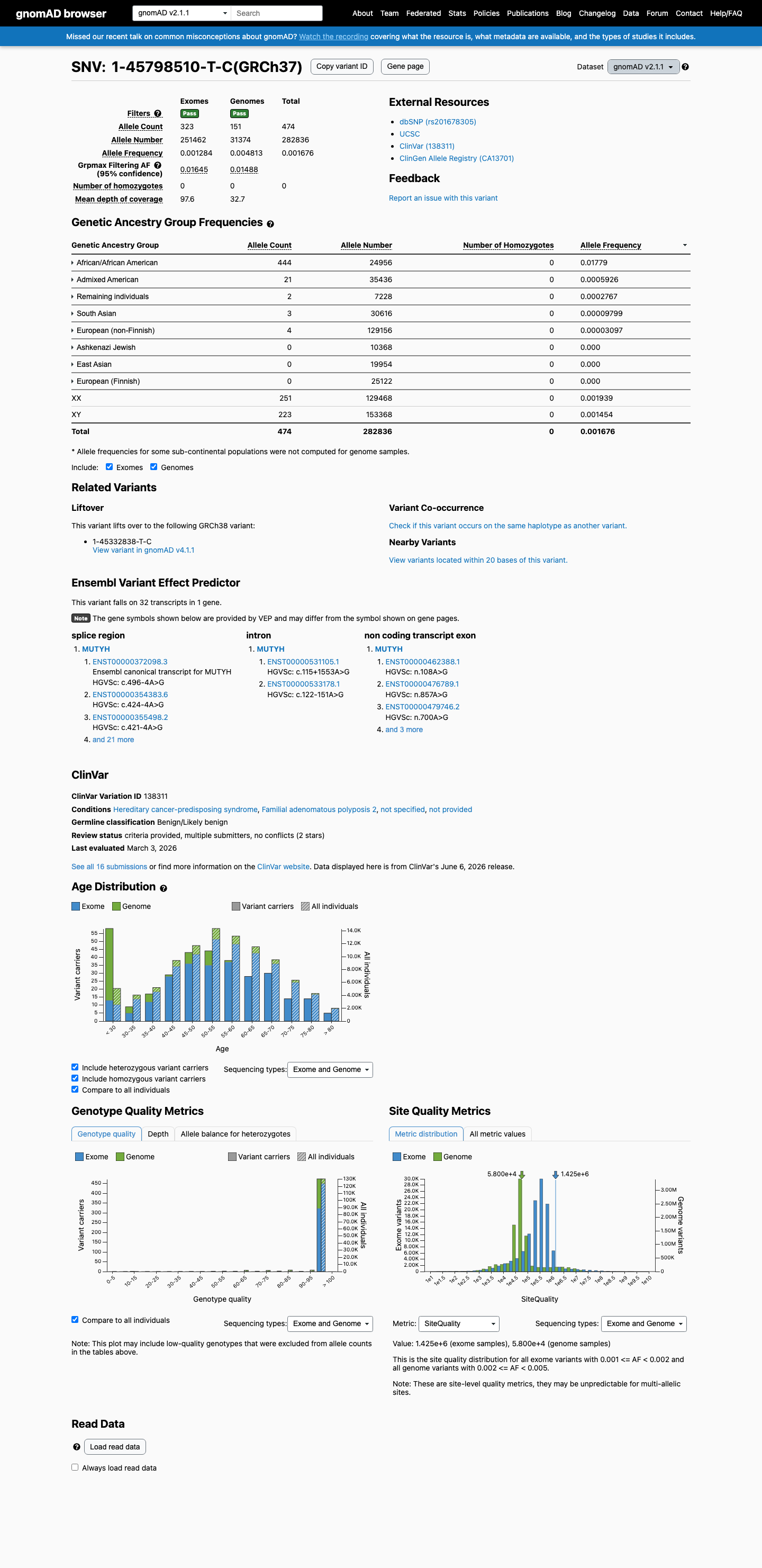
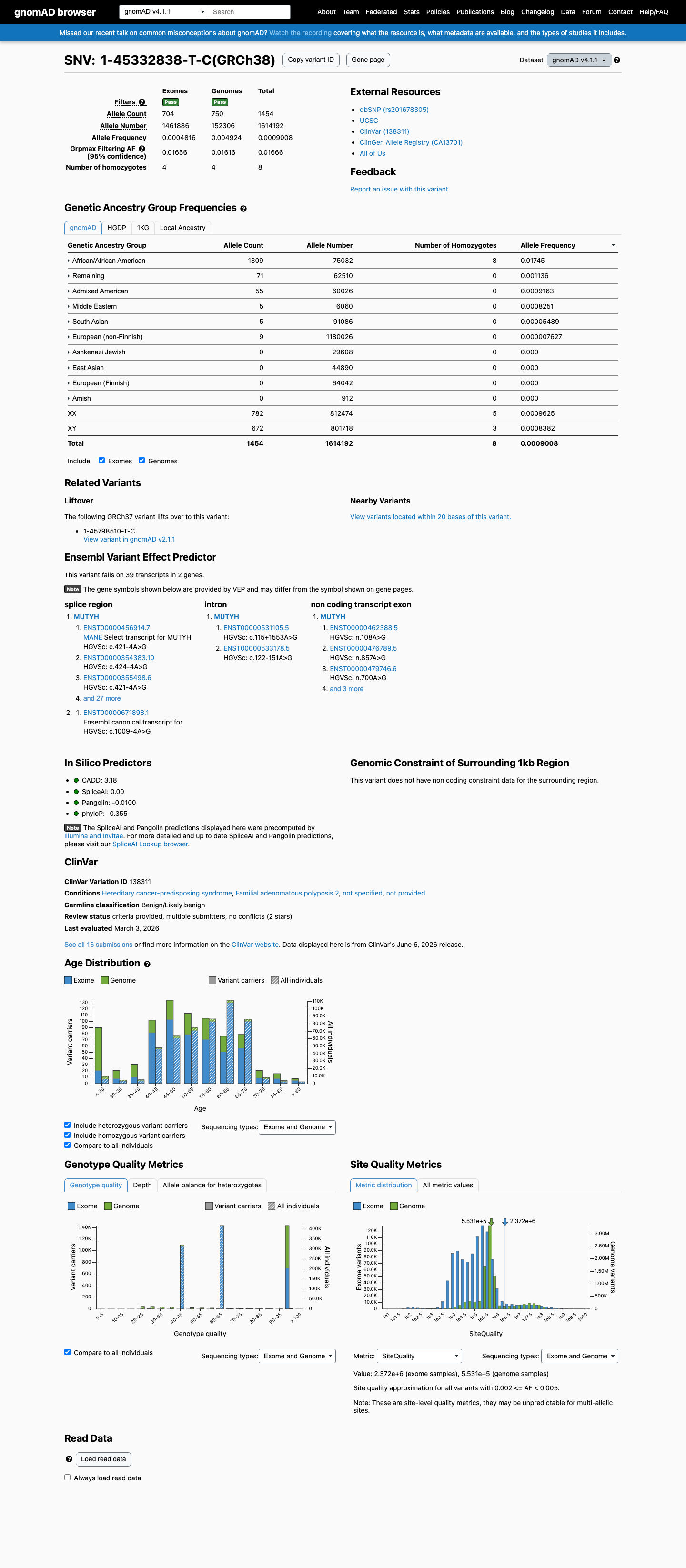
BS1 threshold applied verbatim from the supplied generic calibration block: filtering allele frequency >= 0.01, described there as the generic SVI default with per-gene derivation preferred (Whiffin et al. 2017, PMID:28518168); the criterion itself is defined in ACMG/AMP 2015 as an allele frequency greater than expected for the disorder (PMID:25741868).gnomAD v2.1 all-comers: grpmax FAF 0.0164467; highest ancestry African/African American AF 0.0177913 (444/24956 alleles, 0 homozygotes); total AF 0.00167588 (474/282836).gnomAD v4.1 all-comers: grpmax FAF 0.0166596 (exome grpmax FAF 0.0165617); highest ancestry African/African American AF 0.0174459 (1309/75032 alleles, 8 homozygotes); total AF 0.00090076 (1454/1614192).
BP4 supporting Benign
Met at supporting: SpliceAI max delta 0.024 sits at or below the 0.1 BP4 threshold, predicting no splice impact.
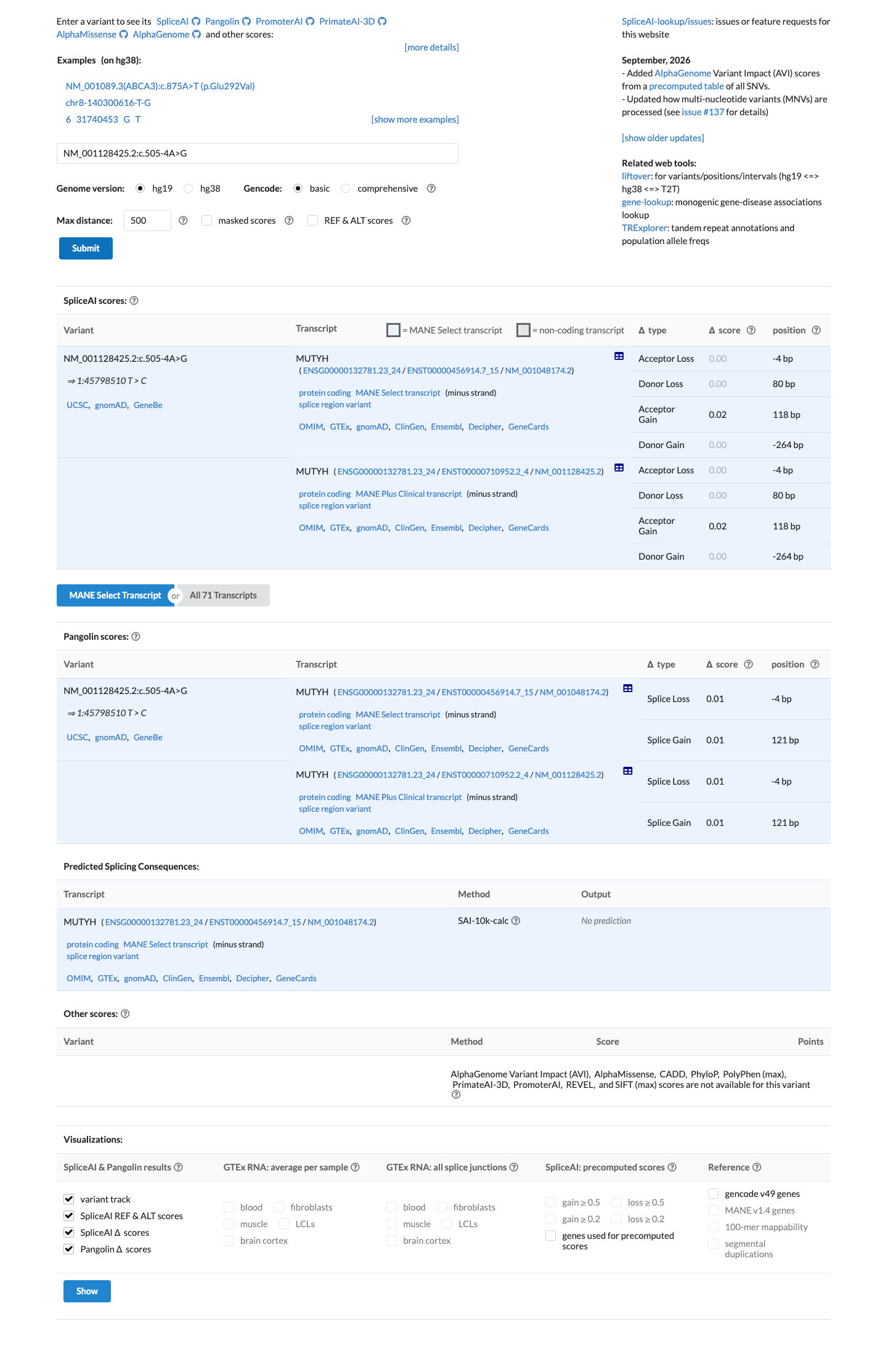
SpliceAI max delta score 0.024 for NM_001128425.2:c.505-4A>G (hg37 1-45798510-T-C and hg38 chr1-45332838-T-C), retrieved directly from the Broad SpliceAI Lookup scoring service; identical value for the MANE Plus Clinical transcript ENST00000710952.2 and for all other annotated transcripts.Applied generic ClinGen-SVI SpliceAI cutoff: BP4 supporting when max delta <= 0.1 (Jaganathan et al. 2019, Cell, PMID:30661751). 0.024 <= 0.1, so BP4 supporting is met.BP4 taken from the SpliceAI path only, because the variant is intronic; no REVEL score exists or applies, and a clean/absent splice signal was not mixed with any protein-level predictor.
Assessed · not applied · 11 not met · 8 not assessed
Pathogenic
PVS1 Not met: c.505-4A>G is a non-canonical intronic substitution four bases from the exon boundary, not a null variant, with no splice prediction or RNA evidence of an aberrant transcript.
PS2 Not assessed: zero probands and zero parental genotypes exist in the case record, so confirmed de novo occurrence cannot be established.
PS3 Not met: no RNA or enzyme-activity assay of c.505-4A>G exists, and none of the 13 usable ClinVar submissions reports functional evidence.
PS4 Not met: no case-control data exist and gnomAD grpmax FAF 0.0167 with 8 homozygotes is incompatible with the OR > 5.0 enrichment PS4 requires.
PM1 Not met: c.505-4A>G is intronic with no amino-acid change, no MUTYH domain table exists, and no hotspot annotation places it in a functional domain.
PM2 Not met: gnomAD v4.1 total allele frequency 0.09% (1454 alleles; grpmax FAF 1.67%) far exceeds the 0.01% supporting threshold.
PM3 Not assessed: no affected proband reported with c.505-4A>G in trans with a pathogenic MUTYH allele; only population data (gnomAD v4.1: 8 homozygotes, 0.09% AF) are available.
PM6 Not assessed: no proband and no parental genotypes are available in the case, so an assumed de novo occurrence cannot be established.
PP1 Not assessed: no pedigree, affected relatives, or countable meioses exist in the case, so co-segregation cannot be evaluated.
PP3 Not met: SpliceAI max delta 0.024 is below the 0.2 supporting PP3 threshold for this intronic acceptor-region variant.
PP4 Not assessed: no proband phenotype or family history exists in this variant-level case, and MUTYH adenomatous polyposis is not specific to a single genetic etiology.
PP5 Not met: the exact-variant ClinVar record has zero expert-panel submissions and a benign consensus, so no expert-panel pathogenic assertion exists to trigger PP5.
Benign
BA1 Not met: the highest ancestry frequency, 1.78% (gnomAD v2.1 African/African American; grpmax FAF 1.64%), is far below the 5% stand-alone threshold.
BS2 Not met: MAP is adult-onset (mid-50s) and incompletely penetrant, so BS2's full-penetrance-at-early-age premise fails despite 8 homozygotes in gnomAD v4.1.
BS3 Not met: no assay of c.505-4A>G demonstrates preserved function; Pangolin splice gain 0.014 is computational, not functional, evidence.
BS4 Not assessed: no pedigree or genotyped affected relatives exist, so non-segregation within a family cannot be evaluated.
BP2 Not assessed: no individual documented with c.505-4A>G in cis with a pathogenic MUTYH variant; phase data absent, so the BP2 allelic test cannot be applied.
BP5 Not assessed: no case-level genotype data exist, so no patient with an alternate molecular basis for the polyposis phenotype could be identified or excluded.
BP6 Not met: the exact-variant ClinVar benign consensus comes from 16 ordinary laboratory submissions with zero expert-panel classifications, which cannot trigger BP6.
N/A · 7 PS1 · PM4 · PM5 · PP2 · BP1 · BP3 · BP7
Research & evidence
Population frequency · supports benign
gnomAD v4.1 screenshot
gnomAD v4.1
gnomAD v2.1 screenshot
gnomAD v2.1
v4.1
This variant is present in gnomAD v4.1 (AF= 0.00090076; MAF= 0.09008%, 1454/1614192 alleles, homozygotes = 8) and has highest observed frequency in the African/African American population (AF= 0.0174459; MAF= 1.74459%, 1309/75032 alleles, homozygotes = 8); grpmax FAF= 0.0166596.
v2.1
This variant is present in gnomAD v2.1 (AF= 0.00167588; MAF= 0.16759%, 474/282836 alleles, homozygotes = 0) and has highest observed frequency in the African/African American population (AF= 0.0177913; MAF= 1.77913%, 444/24956 alleles, homozygotes = 0); grpmax FAF= 0.0164467.
🇨🇦 CA
This variant is present in gnomAD-Canada v1.0 (AF= 0.0007059079061685491, 13/18416 alleles, homozygotes = 0).
Allele frequency by ancestry
three datasets · side by side
gnomAD v4.1
0.09% · 1454 / 1,614,192
8 hom · FAF 1.7%
African/African American
1309 / 75,032
1.7%
8 hom
Remaining individuals
71 / 62,510
0.11%
Admixed American
55 / 60,026
0.092%
Middle Eastern
5 / 6,060
0.083%
South Asian
5 / 91,086
0.0055%
European (non-Finnish)
9 / 1,180,026
0.00076%
+ 4 not observed (European (Finnish), Amish, East Asian, Ashkenazi Jewish)
gnomAD v2.1
0.17% · 474 / 282,836
0 hom · FAF 1.6%
African/African American
444 / 24,956
1.8%
Admixed American
21 / 35,436
0.059%
Remaining individuals
2 / 7,228
0.028%
South Asian
3 / 30,616
0.0098%
European (non-Finnish)
4 / 129,156
0.0031%
+ 3 not observed (Ashkenazi Jewish, East Asian, European (Finnish))
gnomAD Canada 🇨🇦
0.071% · 13 / 18,416
0 hom · FAF 0.6%
African/African American
11 / 1,020
1.1%
Latino/Admixed American
1 / 838
0.12%
Remaining individuals
1 / 1,138
0.088%
+ 6 not observed (Ashkenazi Jewish, East Asian, European (Finnish), Middle Eastern, European (non-Finnish), South Asian)
ClinVar screenshot
ClinVar
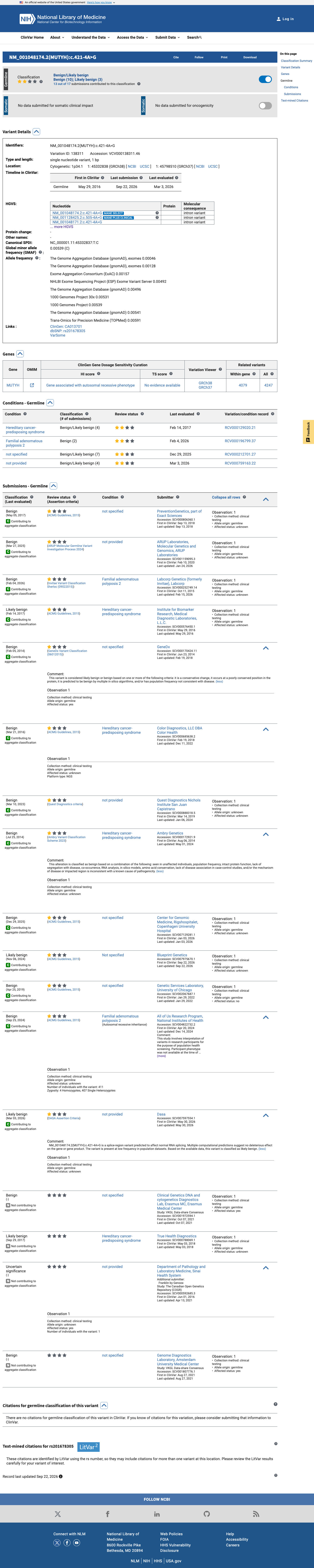
This variant has been reported in ClinVar as Benign (12 clinical laboratories) and as Likely benign (4 clinical laboratories) and as Uncertain significance (1 clinical laboratory). (ClinVarID = 138311)
SpliceAI screenshot
In silico
SpliceAI returned NO scores for this variant, so no SpliceAI-based splice prediction is available. This is missing data, NOT evidence of absent splice impact: it must not be used to support BP4 or to argue against PP3/PVS1. Pangolin scores may be present but are not calibrated for PP3/BP4 here.
Functional No data
No calibrated functional assay or RNA evidence was identified for this variant.
OncoKB ↗
COSMIC screenshot
COSMIC
Somatic evidence
COSMIC
This variant has not previously been reported in somatic cancers (COSMIC).
Hotspots
This variant does not lie in a statistically significant cancer hotspot.
COSMIC ↗
Literature · how each cited paper was used
3papers cited
Each card is an audit: what was searched, what was found, whether it names the variant, which criteria it fed, and why. 5 further PMIDs triaged but not cited — see Sources & references.
Rule & framework references · cited for criterion definitions, not variant evidence
25452455 ↗ Hereditary colorectal cancer syndromes: American Society of Clinical Oncology Clinical Practice Guideline endorsement of the familial risk-colorectal cancer: European Society for Medical Oncology Clinical Practice Guidelines.
25741868 ↗ Standards and guidelines for the interpretation of sequence variants: a joint consensus recommendation of the American College of Medical Genetics and Genomics and the Association for Molecular Pathology.
26467025 ↗ A Standardized DNA Variant Scoring System for Pathogenicity Assessments in Mendelian Disorders.
Sources & reference links
8Sources
CSpec VCEP
ClinVar
gnomAD v2.1
gnomAD v4.1
gnomAD-Canada
SpliceAI
OncoKB
COSMIC
Triaged references · 5 PMIDs not cited in assessment
21325953 ↗ Lynch syndrome and MYH-associated polyposis: review and testing strategy. CLINVAR
25645574 ↗ ACG clinical guideline: Genetic testing and management of hereditary gastrointestinal cancer syndromes. CLINVAR
23788249 ↗ ACMG recommendations for reporting of incidental findings in clinical exome and genome sequencing. CLINVAR
27854360 ↗ Recommendations for reporting of secondary findings in clinical exome and genome sequencing, 2016 update (ACMG SF v2.0): a policy statement of the American College of Medical Genetics and Genomics. CLINVAR
28492532 ↗ Sherloc: a comprehensive refinement of the ACMG-AMP variant classification criteria. CLINVAR