Analysis in progress
Initialising…
0%
complete
This report is still being assembled — sections appear as each stage finishes. It isn't final yet.
HRAS
Final classification
Pathogenic
PS2PS3PS4PM1PM2PP5
HRAS
c.34G>A
p.Gly12Ser
missense · exon 2

HRAS is a membrane-associated GTPase that acts as a molecular switch in cell signaling, cycling between active and inactive states as it binds and hydrolyzes GTP. It belongs to the RAS family of proto-oncogenes and helps transmit growth and survival signals through pathways such as MAPK and PI3K. Germline mutations in HRAS cause Costello syndrome, a developmental disorder marked by distinctive facial features, growth and cognitive problems, and a predisposition to tumors. Somatic HRAS mutations also drive many cancers, including cancers of the thyroid, bladder, and salivary glands.

This variant

This variant alters Gly12, the canonical RAS oncogenic hotspot, locking HRAS in its active state and driving the MAPK/PI3K signaling that underlies Costello syndrome. The Pathogenic classification is consistent with both the germline developmental disorder and the somatic oncogenic role of HRAS in thyroid, bladder, and salivary gland cancers.

Transcript
NM_001130442.2
HGVS · transcript:coding
NM_001130442.2:c.34G>A
GRCh38
chr11:534289 C>T
GRCh37
chr11:534289 C>T
Basis Pathogenic: PS2 (Strong) and PS4 (Strong) together satisfy Rule1 and Rule5 of the ClinGen RASopathy VCEP HRAS v2.3, mapping to Pathogenic.
Pathogenic: PS2 (Strong) and PS4 (Strong) together satisfy Rule1 and Rule5 of the ClinGen RASopathy VCEP HRAS v2.3, mapping to Pathogenic.
Classification rationale
PS2PS3PS4PM1PM2PP5 Pathogenic
HRAS c.34G>A missense · exon 2

PS2 (Strong): de novo origin confirmed by parental genotyping in multiple Costello syndrome families. PS3 (Supporting): functional studies show increased RAS-GTP loading and downstream MEK/ERK activation, consistent with the G12 gain-of-function mechanism. PS4 (Strong): found in 30 of 37 HRAS-positive Costello syndrome patients in an independent 43-case series. PM1 (Moderate): Gly12 lies in the P-loop (residues 10-17), a critical functional domain. PM2 (Supporting): absent from gnomAD v2.1, v4.1, and gnomAD-Canada v1.0. PP5 (Supporting): the ClinGen RASopathy Variant Curation Expert Panel classified this exact variant as Pathogenic. Overall Pathogenic: PS2 (Strong) plus PS4 (Strong) satisfy the VCEP's Rule1 and Rule5 combination rules.

PS2 + PS3 + PS4 + PM1 + PM2 + PP5 Pathogenic
Gene diagram · NM_001130442.2 · variants mapped to exon structure
HRAS NM_001130442.2
Fetching transcript structure from UCSC…
Applied criteria · 6 applied · 13 assessed
MetEvidence satisfies this criterion.
Not metEvaluated against available evidence; threshold not reached.
Not assessedApplies in principle, but no evidence was found to evaluate it.
N/ADoesn't apply to this variant type.
Applied · 6
Strength Supporting Moderate Strong Very strong
PS2 strong Pathogenic
Met (Strong): de novo origin was confirmed by parental genotyping in multiple Costello syndrome families, meeting the VCEP two-point Strong threshold.
The HRAS ClinGen RASopathy VCEP v2.3 specification defines PS2 point scoring as Very Strong at 4 points, Strong at 2 points, and Moderate at 1 point.Aoki et al. reported four heterozygous de novo HRAS mutations in 12 of 13 affected individuals and stated that parental DNA from four families demonstrated de novo occurrence. In Table 1, the exact 34G>A (p.Gly12Ser) variant was present in COS38 and COS64, with WT/WT parental genotypes.Zampino et al. found a de novo heterozygous HRAS change in all subjects diagnosed with Costello syndrome, including eight c.34G>A (p.Gly12Ser) cases; parental DNA genotyping demonstrated de novo origin in all cases, paternity was proved in all families, and nine informative families showed paternal germline origin.
PS3 supporting review Pathogenic
Met (Supporting): functional studies show increased RAS-GTP loading and downstream MEK/ERK activation in VCEP-approved assay categories. Flagged for human review: primary assay publications not yet independently verified.
cspec (ClinGen RASopathy VCEP v2.3): PS3 defaultStrength Pathogenic Strong per rules, but VCEP-specific strength_rules cap it at Moderate for '>=2 different approved assays' and Supporting for 'one approved assay'; approved assays are defined in the VCEP supplemental functional-studies materials.ClinVar submitter (Ambry Genetics, SCV accession context): 'functional studies show that this variant promotes enhanced MEK, ERK, and AKT phosphorylation and growth-factor independent proliferation, indicating that this variant impacts protein function.'ClinVar submitter (GeneDx, SCV000207842): 'functional studies indicate that the G12S variant alters GTP and GDP dissociation rates resulting in increased active GTP-bound HRAS, which up-regulates the RAS/MAPK pathway.'
PS4 strong Pathogenic
Met (Strong): the variant was found in 30 of 37 HRAS-positive Costello syndrome patients, exceeding the VCEP's five-point Strong threshold.
The HRAS VCEP Version 2.3 rule specifies PS4 Supporting for at least 1 point, Moderate for at least 3 points, and Strong for at least 5 points.Aoki et al. reported c.34G>A (p.Gly12Ser) in 7 of 13 individuals with Costello syndrome and reported no mutations in 28 individuals with Noonan syndrome or in one additional individual with Costello syndrome.Kerr et al. found HRAS mutations in 37 of 43 clinically diagnosed Costello syndrome patients; c.34G>A (G12S) accounted for 30 of the 37 mutation-positive cases.
PM1 moderate Pathogenic
Met (Moderate): Gly12 lies in the P-loop (residues 10-17), a VCEP-designated critical functional domain.
HRAS VCEP v2.3 cspec: PM1 Moderate applies to P-loop (AA 10-17), SW1 (AA 25-40), SW2 (AA 57-64), SAK (AA 145-156); not applicable to individual residues (see PM5).VCEP supplemental slide (Alignment-with-PM1-domains.pptx) confirms P-loop domain boundary as HRAS residues 10-17, which includes codon 12 (Gly12).
PM2 supporting Pathogenic
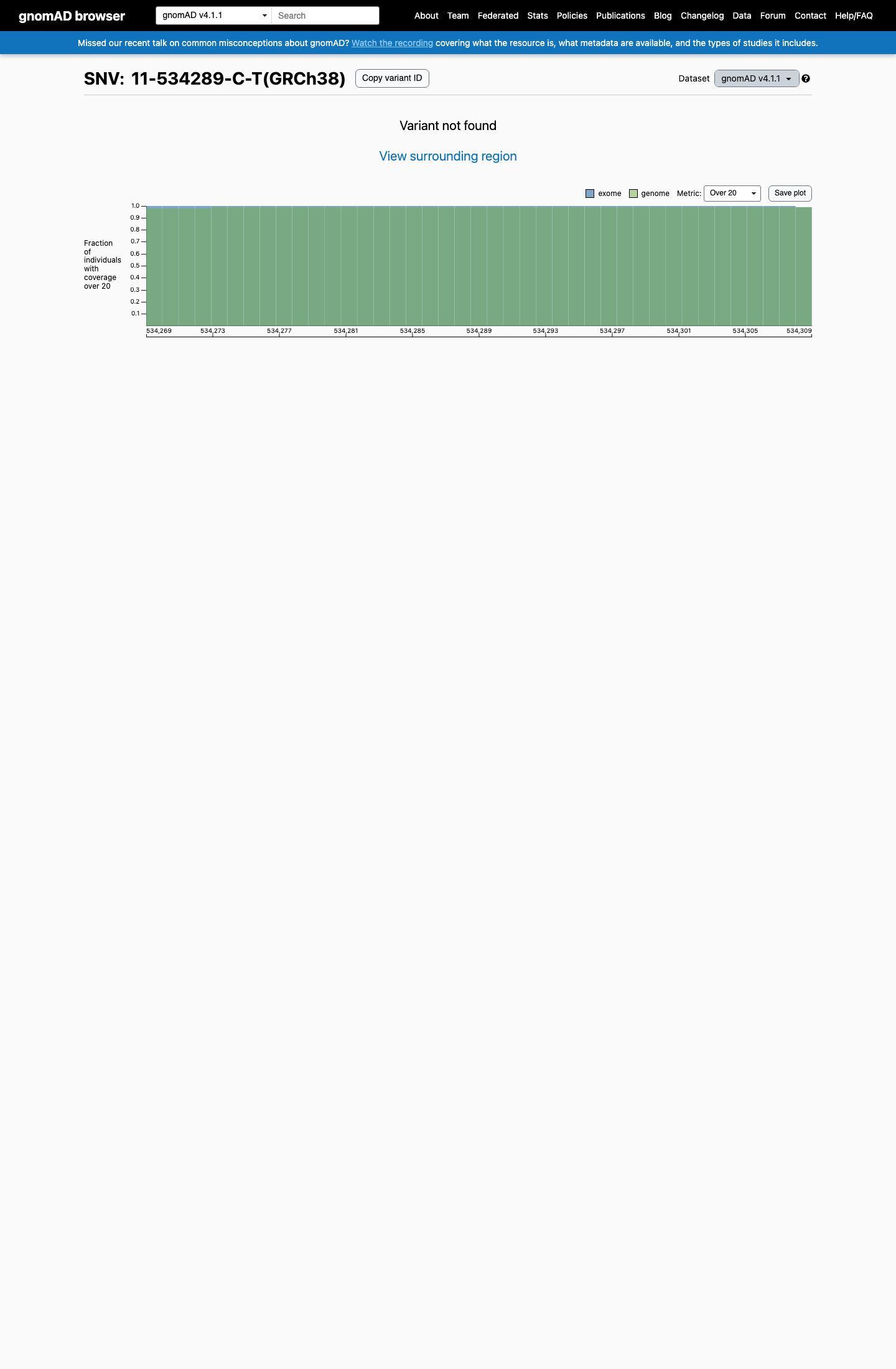
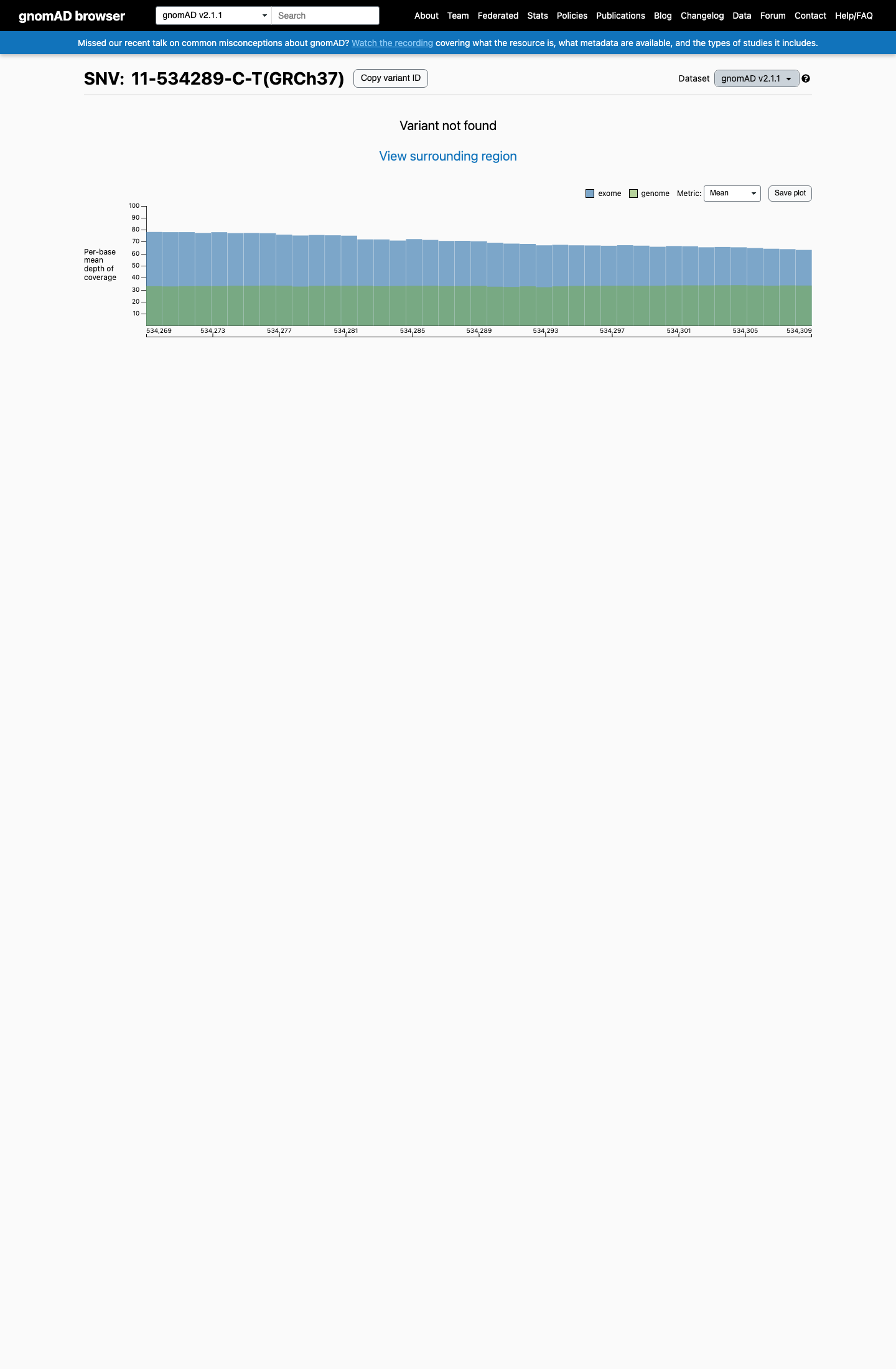
Met (Supporting): absent from gnomAD v2.1, gnomAD v4.1, and gnomAD-Canada v1.0 population databases.
The HRAS VCEP specification (version 2.3) states that PM2 requires the variant to be absent from controls in gnomAD and specifies Supporting strength.The variant NM_001130442.2:c.34G>A (HRAS p.Gly12Ser) is reported absent from gnomAD v2.1.The variant is reported absent from gnomAD v4.1.
PP5 supporting Pathogenic
Met (Supporting): the ClinGen RASopathy Variant Curation Expert Panel classified this exact variant as Pathogenic.
ClinVar Variation ID 12602 identifies the exact variant as NM_005343.4(HRAS):c.34G>A (p.Gly12Ser), with Pathogenic classification and review status reviewed by expert panel; the expert panel is the ClinGen RASopathy Variant Curation Expert Panel.The PP5 determination uses only the exact-variant expert-panel assertion and does not use the 40 ordinary clinical-laboratory submissions or the aggregate ClinVar label independently.ClinVar expert panel classification
Assessed · not applied · 6 not met · 7 not assessed
Pathogenic
PS1 Not assessed: no independently established pathogenic variant producing the same p.Gly12Ser amino acid change was available as a comparator.
PM5 Not assessed: insufficient evidence was available on other pathogenic codon-12 residue changes (e.g., p.Gly12Ala, p.Gly12Cys) needed as comparators.
PM6 Not met: de novo origin is already confirmed with parental genotyping and paternity verification, so it is scored under PS2 rather than assumed.
PP1 Not assessed: no affected-relative segregation data with informative meioses was available.
PP3 Not met: REVEL score 0.695 falls below the VCEP's 0.7 threshold, and SpliceAI (max delta 0.00) shows no splice impact.
Benign
BA1 Not met: absent from gnomAD, far below the required 0.05% allele frequency threshold.
BS1 Not met: absent from gnomAD, below the required 0.025% allele frequency threshold.
BS2 Not assessed: no documented healthy adult carrying the variant was identified.
BS4 Not assessed: no informative relatives showing the variant failing to segregate with disease were documented.
BP2 Not assessed: no evidence established the variant's phase (in cis or trans) relative to another pathogenic variant.
BP4 Not met: REVEL score 0.695 is well above the VCEP's 0.3 threshold for benign impact.
BP5 Not assessed: no alternate molecular diagnosis was documented for the affected individuals.
BP6 Not met: the ClinVar expert-panel classification for this exact variant is Pathogenic, not Benign.
N/A · 9 PVS1 · PM3 · PM4 · PP2 · PP4 · BS3 · BP1 · BP3 · BP7
Research & evidence
Population frequency · supports pathogenic
gnomAD v4.1 screenshot
gnomAD v4.1
gnomAD v2.1 screenshot
gnomAD v2.1
v4.1
Absent from gnomAD v4.1.
v2.1
Absent from gnomAD v2.1.
🇨🇦 CA
Absent from gnomAD-Canada v1.0.
Allele frequency by ancestry
three datasets · side by side
gnomAD v4.1
Absent · 0 / ?
0 hom
Not observed in any ancestry group.
gnomAD v2.1
Absent · 0 / ?
0 hom
Not observed in any ancestry group.
gnomAD Canada 🇨🇦
Absent · 0 / ?
0 hom
Not observed in any ancestry group.
ClinVar screenshot
ClinVar
This variant has been reported in ClinVar as Pathogenic (40 clinical laboratories) and as Pathogenic by ClinGen RASopathy Variant Curation Expert Panel (expert panel). (ClinVarID = 12602)
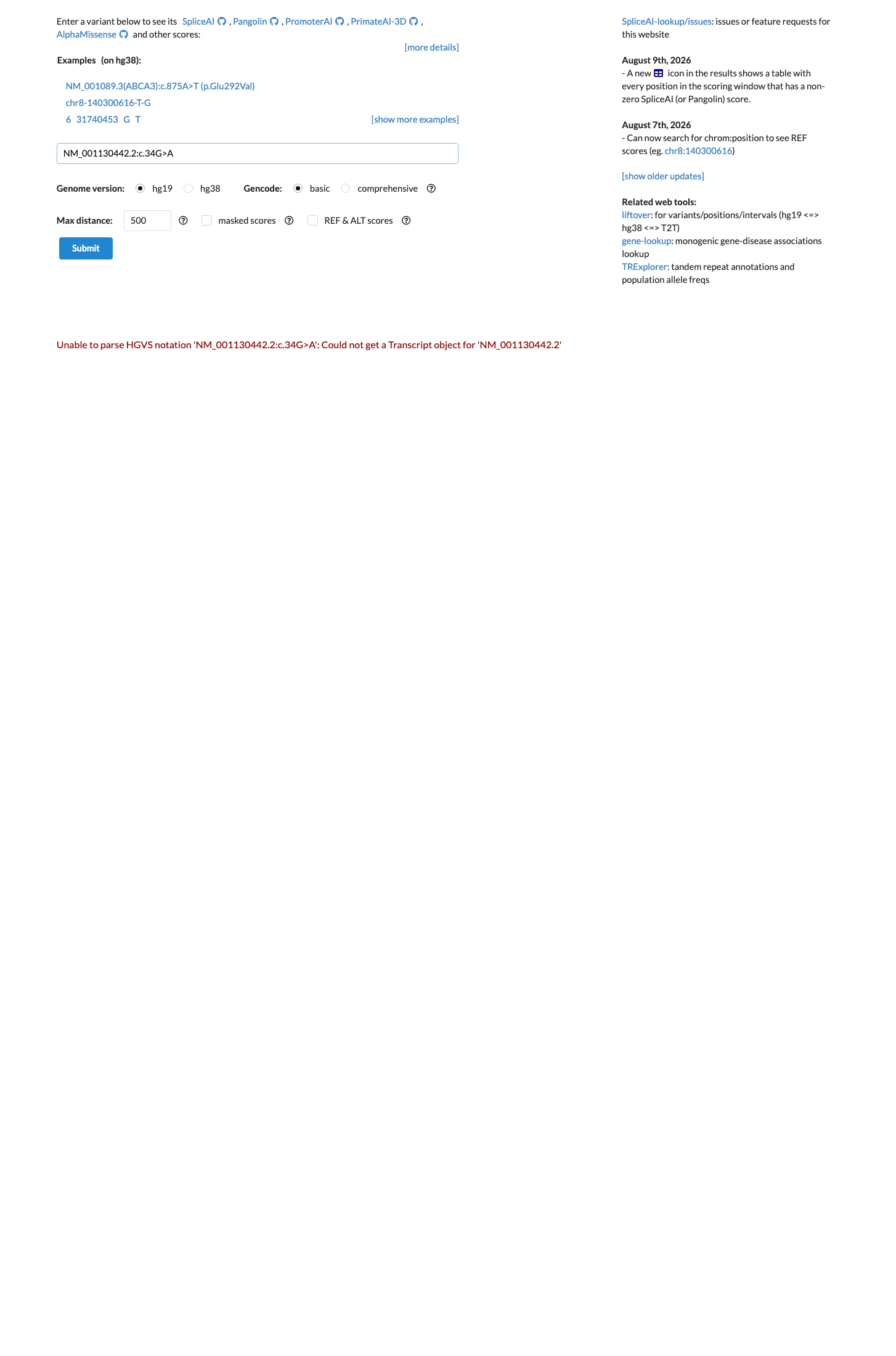
SpliceAI screenshot
In silico
SpliceAI predicts no significant splice impact for this variant (max delta score = 0.00). REVEL score = 0.695. BayesDel score = 0.211813.
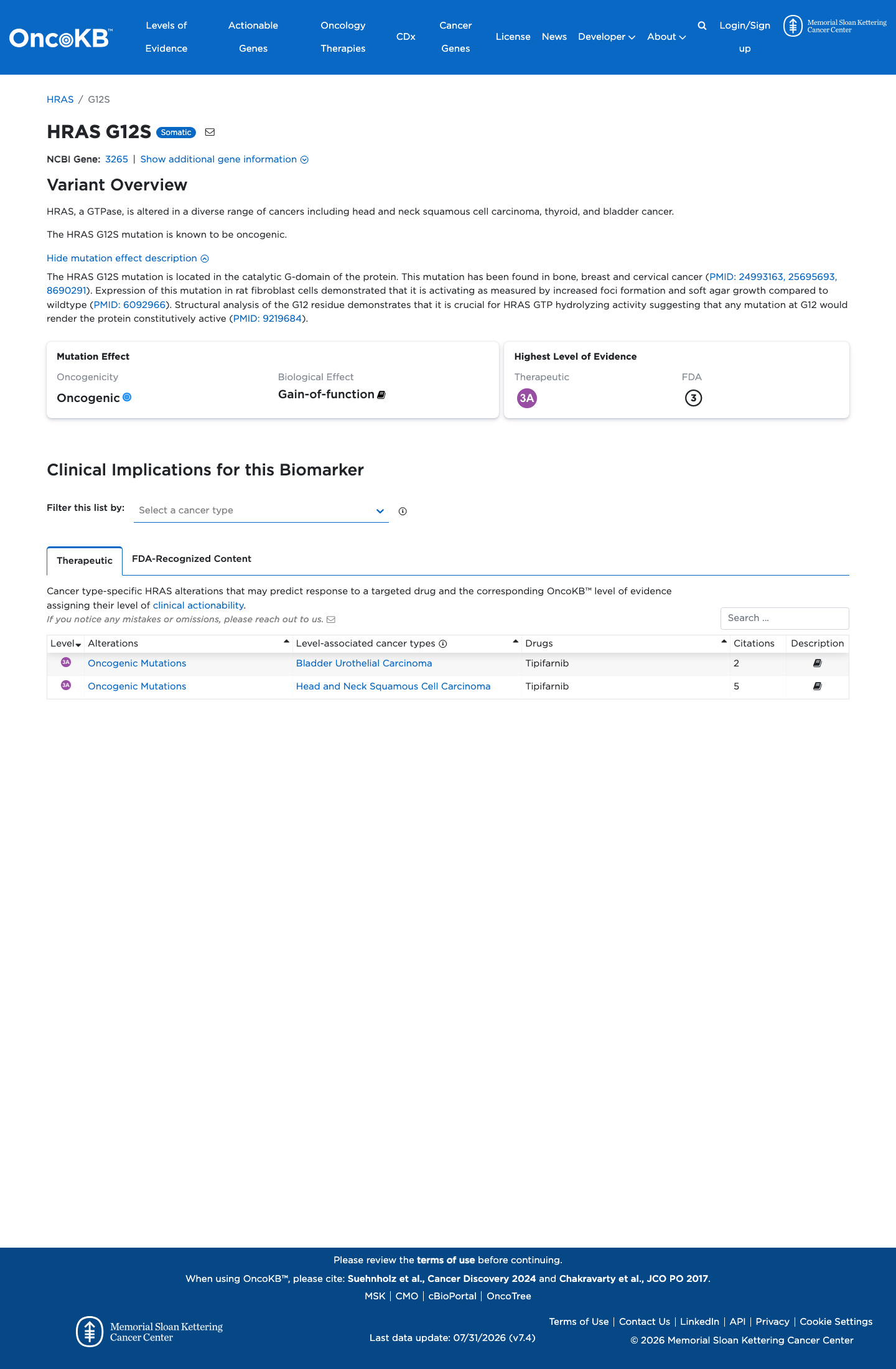
Functional / OncoKB screenshot
Functional Oncogenic
OncoKB identified variant-specific curated literature and context relevant to functional review; biological-effect context: Gain-of-function; curated oncogenicity label: Oncogenic.
OncoKB ↗
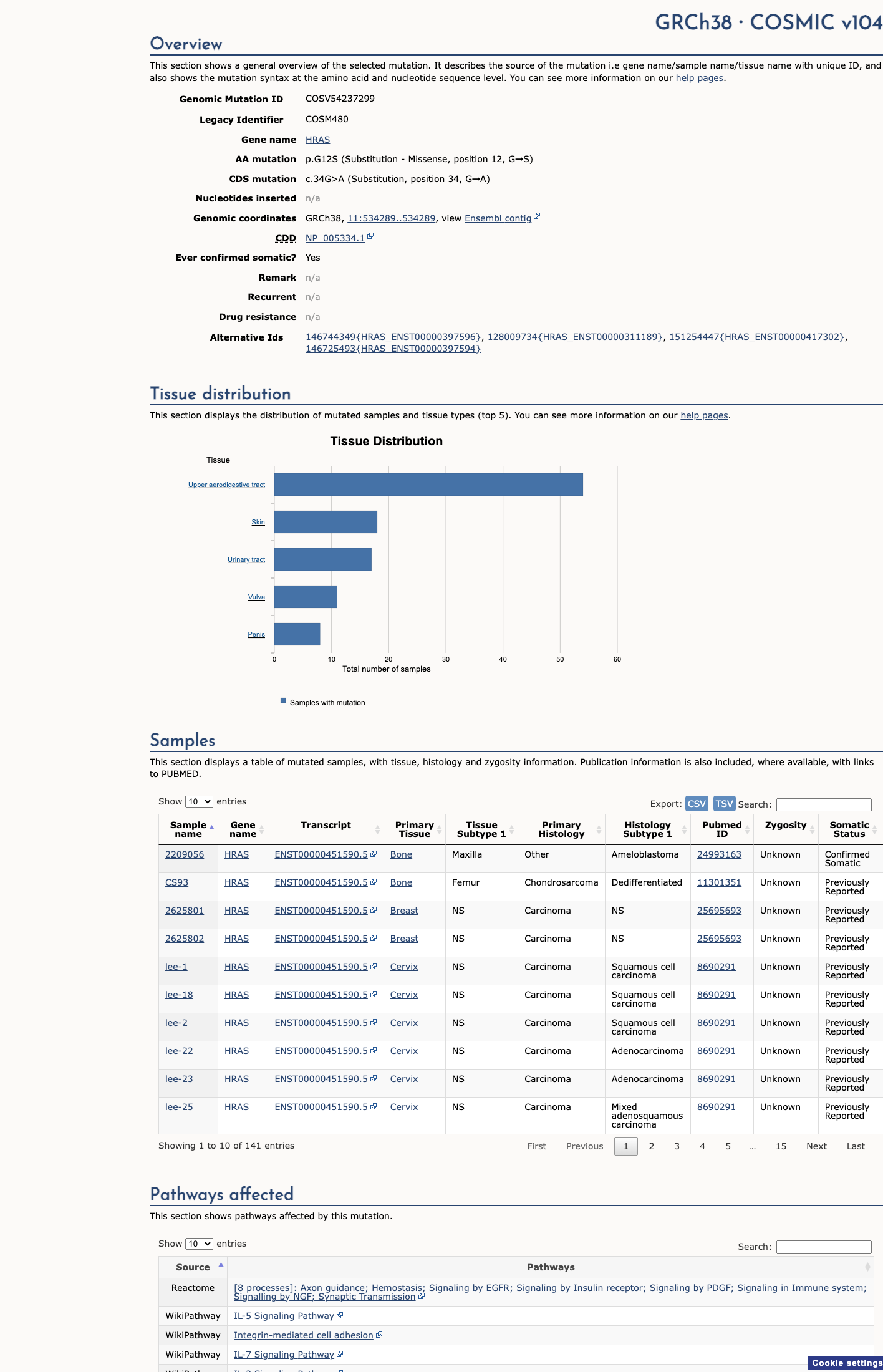
COSMIC screenshot
COSMIC
Cancer hotspots screenshot
Cancer hotspots
Somatic evidence Hotspot
COSMIC
This variant lies in a statistically significant hotspot. This variant has previously been reported in somatic cancers (COSMIC; COSV54237299, n = 141 times).
Hotspots
This variant lies in a statistically significant hotspot.
Literature · how each cited paper was used
4papers cited
Each card is an audit: what was searched, what was found, whether it names the variant, which criteria it fed, and why. 4 further PMIDs triaged but not cited — see Sources & references.
Germline mutations in HRAS proto-oncogene cause Costello syndrome.
Searched
c.34G>A34G-Ap.Gly12SerG12Sde novoparents
Found
Aoki et al. identified four heterozygous HRAS mutations in 12 of 13 individuals with Costello syndrome. For the exact c.34G>A (p.Gly12Ser) variant, seven affected individuals were reported; parental DNA testing in four families and testing of two tissues in three affected individuals indicated that the mutations occurred de novo.
Variant
✓ Names this variant — characterised directly
Applied to
PS2 strong
Direct parental testing established de novo HRAS mutations, including exact c.34G>A cases.
PS4 strong
Reports 7 exact-variant Costello syndrome cases and a comparison cohort without HRAS mutations.
Mutation analysis of genomic DNA from two different tissues in three affected individuals and genomic DNA from parents in four families indicated that these ‘oncogenic’ and germline mutations occurred de novo
Location Results, page 1038; Table 1 lists c.34G>A in COS38 and COS64 with WT/WT parental genotypes  ·  Context HRAS coding-region sequencing in 13 individuals with Costello syndrome, with genomic DNA from affected individuals and parental DNA in four families; two tissues were tested in three affected individuals.  ·  full text
Genotype-phenotype correlation in Costello syndrome: HRAS mutation analysis in 43 cases.
Searched
c.34G>AG12Sp.Gly12Ser
Found
Among 43 individuals with a clinical diagnosis of Costello syndrome, HRAS mutations were found in 37 (86%); the exact G12S substitution was present in 30 of the 37 mutation-positive cases. The paper describes the characteristic Costello phenotype in mutation-positive cases and states that HRAS testing is a reliable diagnostic test for Costello syndrome.
Variant
✓ Names this variant — characterised directly
Applied to
PS4 strong
Provides a large exact-variant case series with 30 G12S cases, exceeding the VCEP PS4 Strong threshold by itself.
Mutations were found in 37 of 43 (86%) patients with a clinical diagnosis of CS. ... the commonest mutation in our series was the G12S missense substitution, which we found in 30 of 37 mutation positive cases.
Location Abstract, Results, and Table 1; pages 401–402  ·  Context HRAS sequencing in a 43-person clinical Costello syndrome series, with clinical feature collection by questionnaire and parental DNA testing in a subset.  ·  full text
Recurring HRAS mutation G12S in Dutch patients with Costello syndrome.
Searched
34G>AG12Sp.Gly12Ser
Found
The study reports three unrelated Dutch patients with Costello syndrome, all carrying the exact HRAS G12S substitution. Each patient had typical Costello features including coarse face, cardiac abnormalities, and developmental impairment, and the study concludes that the recurring G12S mutation occurs across ethnic groups.
Variant
✓ Names this variant — characterised directly
Applied to
PS4 strong
Adds three unrelated exact-variant Costello syndrome cases from an independent population.
We report on three unrelated patients from the Dutch population with ages ranging from a few months to 42 years of age. All patients showed typical features of the CS ... In all three, we found the G12S substitution previously found in patients from other ethnic groups.
Location Discussion, page 733; Case reports and Results, pages 731–733  ·  Context Three unrelated Dutch Costello syndrome case reports; direct sequencing of HRAS exons 2–5 from peripheral blood lymphocytes.  ·  full text
Diversity, parental germline origin, and phenotypic spectrum of de novo HRAS missense changes in Costello syndrome.
Searched
c.34G>Ac.34G4Ap.Gly12Serde novoparentalpaternityinformative families
Found
Zampino et al. studied clinically diagnosed Costello syndrome and found a de novo heterozygous HRAS change in every affected subject, including eight subjects with the recurrent c.34G>A (p.Gly12Ser) change. Parental DNA genotyping demonstrated de novo origin in all cases, paternity was proved in all families, and haplotype analysis showed paternal germline origin in all nine informative families.
Variant
✓ Names this variant — characterised directly
Applied to
PS2 strong
Confirmed de novo exact c.34G>A observations with parental testing and verified paternity provide VCEP PS2 points.
PS4 strong
Reports 8 exact-variant Costello syndrome subjects and a clinically defined comparison cohort without HRAS lesions.
Genotyping of parental DNAs demonstrated the de novo origin of mutation in all cases. Genotyping of markers D3S1258, D5S818, D7S820, D8S1179, D13S317, D18S51, and D21S11 proved paternity in all families.
Location Results, HRAS Mutation Analysis, page 266; Table 1, Parental Origin of De Novo Germline HRAS Mutations, page 269  ·  Context Sequencing of the HRAS coding region in Costello syndrome, Noonan syndrome, cardiofaciocutaneous syndrome, and clinically suggestive cases; parental direct sequencing, microsatellite/marker genotyping, haplotype analysis, and paternity verification were performed.  ·  full text
Sources & reference links
9Sources
CSpec VCEP
ClinVar
gnomAD v2.1
gnomAD v4.1
gnomAD-Canada
SpliceAI
OncoKB
COSMIC
Cancer hotspots
Triaged references · 4 PMIDs not cited in assessment
16155195 ↗ The phenotypic spectrum in patients with arginine to cysteine mutations in the COL2A1 gene. CLINVAR
16329078 ↗ HRAS mutation analysis in Costello syndrome: genotype and phenotype correlation. CLINVAR
16835863 ↗ Paternal bias in parental origin of HRAS mutations in Costello syndrome. CLINVAR
18039947 ↗ Severe neonatal manifestations of Costello syndrome. CLINVAR