Back
NM_006231.4:c.4477G>C
p.Ala1493Pro · POLE
León-Castillo et al. 2020 custom POLE framework · vleon-castillo-2020-custom-framework-v1
0%
complete
Final classification
Likely Benign
PM2BP4
POLE
c.4477G>C
p.Ala1493Pro
missense · exon 35

POLE encodes the catalytic subunit of DNA polymerase epsilon, the enzyme that replicates the leading strand of DNA during cell division and participates in DNA repair. It contains a proofreading domain that corrects replication errors, keeping the accumulation of mutations in check. Germline mutations in POLE cause polyposis and predispose to colorectal cancer, and are also linked to a rare syndrome of facial dysmorphism, immunodeficiency, livedo, and short stature. Somatic mutations, particularly in the proofreading domain, occur in colorectal and endometrial cancers, where they drive an ultra-mutated tumor phenotype and are associated with better responses to immune checkpoint inhibitors.

This variant

This POLE missense variant affects the catalytic DNA polymerase epsilon subunit, whose proofreading and repair functions are relevant to inherited polyposis and colorectal-cancer predisposition.

Transcript
NM_006231.4
HGVS · transcript:coding
NM_006231.4:c.4477G>C
GRCh38
chr12:132643298 C>G
GRCh37
chr12:133219884 C>G
Likely Benign: PM2 (supporting) and BP4 (supporting) satisfy the POLE framework's rule for two supporting benign criteria.
Classification rationale
PM2 BP4 Likely Benign
POLE c.4477G>C missense · exon 35

Likely Benign: PM2 supporting reflects absence from gnomAD v2.1 and v4.1. Likely Benign: BP4 supporting reflects a REVEL score of 0.147 below 0.250.

PM2 + BP4 → Likely Benign
LYFE Sciences is an AI system, and it can make mistakes. Criteria may be applied incorrectly, sources may be misread, and a confident-looking classification can still be wrong. Double-check every criterion and its underlying evidence before relying on any call.
Gene diagram · NM_006231.4 · variants mapped to exon structure
POLE NM_006231.4
Fetching transcript structure from UCSC…
Applied criteria · 2 applied · 22 assessed
MetEvidence satisfies this criterion.
Not metEvaluated against available evidence; threshold not reached.
Not assessedApplies in principle, but no evidence was found to evaluate it.
N/ADoesn't apply to this variant type.
Applied · 2
Strength Supporting Moderate Strong Very strong
PM2 supporting Pathogenic
Met at supporting: the variant was absent from gnomAD v2.1 and v4.1, consistent with allele frequency 0 versus the <=0.0001 PM2 threshold.
gnomAD v2.1 (exome) reported the variant as absent.gnomAD v4.1 reported the variant as absent.The queried gnomAD v2.1 non-cancer and gnomAD v3.1 non-cancer records also reported the variant as absent; no governing VCEP rule required these subsets instead of the all-comers default.
BP4 supporting Benign
Met at supporting: REVEL 0.147 is below the generic missense BP4 threshold of <0.250 after no exact entry was found in either governing supplementary table.
PATH-250-323.pdf: no row or passage matching c.4477G>C, p.Ala1493Pro, or p.A1493P.PATH-250-323-s003.xlsx, sheet 'Suplementary Table S2': no matching variant row; the table contains missense in-silico results with REVEL class and benign-result count.PATH-250-323-s004.xlsx, sheet 'Supplementary Table S3': no matching variant row; the table contains non-hotspot missense in-silico results with REVEL class and benign-result count.
Assessed · not applied · 4 not met · 18 not assessed
Pathogenic
PS1 Not assessed: no previously established pathogenic variant producing the same Ala1493Pro amino-acid change was identified in the reviewed sources.
PS2 Not assessed: no documented proband phenotype, family-history assessment, parental genotypes, or confirmed maternity and paternity are available.
PS3 Not assessed: no variant-specific validated functional assay or result demonstrating a damaging effect on POLE p.Ala1493Pro is available.
PS4 PS4 could not be assessed because its agent did not produce valid output.
PM1 Not met: Ala1493Pro is absent from all three POLE PM1 substitution lists, including the five established hotspots and ten recurrent exonuclease-domain variants.
PM3 Not assessed: no documented pathogenic second allele, parental testing, phase result, affected proband, or inheritance mode establishes a recessive in-trans observation.
PM5 Not assessed: no different pathogenic missense substitution at the same Ala1493 residue was identified in the reviewed evidence.
PM6 Not assessed: no parental genotypes or parentage information establish that the variant is assumed de novo.
PP1 Not assessed: no affected relatives, informative meioses, segregation results, or phenotype-matched family members are documented.
PP2 Not assessed: the reviewed evidence does not establish both a low benign-missense rate and a common missense disease mechanism for POLE.
PP3 Not met: REVEL 0.147 is below the generic missense PP3 threshold of >0.750 after no exact entry was found in either governing supplementary table.
PP4 PP4 could not be assessed because its agent did not produce valid output.
PP5 PP5 could not be assessed because its agent did not produce valid output.

Benign
BA1 Not met: the variant was absent from gnomAD v2.1 and v4.1, far below the >=0.05 stand-alone benign frequency threshold.
BS1 Not met: gnomAD v2.1 and v4.1 showed no variant observations, below the generic BS1 allele-frequency threshold of >=0.01.
BS2 Not assessed: no healthy adult carrier, zygosity, age, or penetrance observation was documented for this variant.
BS3 Not assessed: no variant-specific validated functional assay or result showing no damaging effect on POLE p.Ala1493Pro is available.
BS4 Not assessed: no affected relatives with documented phenotypes and variant-negative genotypes are available to demonstrate lack of segregation.
BP1 Not assessed: the reviewed evidence does not establish that POLE disease is caused primarily by truncating variants.
BP2 Not assessed: no pathogenic variant or phase result is documented to establish the required cis or trans relationship for BP2.
BP5 BP5 could not be assessed because its agent did not produce valid output.

BP6 BP6 could not be assessed because its agent did not produce valid output.
N/A · 4 PVS1 · PM4 · BP3 · BP7
Research & evidence
Population frequency · supports benign
gnomAD v4.1 screenshot
gnomAD v4.1
gnomAD v2.1 screenshot
gnomAD v2.1
v4.1
Absent from gnomAD v4.1.
v2.1
Absent from gnomAD v2.1.
🇨🇦 CA
Absent from gnomAD-Canada v1.0.
Allele frequency by ancestry
three datasets · side by side
gnomAD v4.1
Absent · 0 / ?
0 hom
Not observed in any ancestry group.
gnomAD v2.1
Absent · 0 / ?
0 hom
Not observed in any ancestry group.
gnomAD Canada 🇨🇦
Absent · 0 / ?
0 hom
Not observed in any ancestry group.
ClinVar screenshot
ClinVar
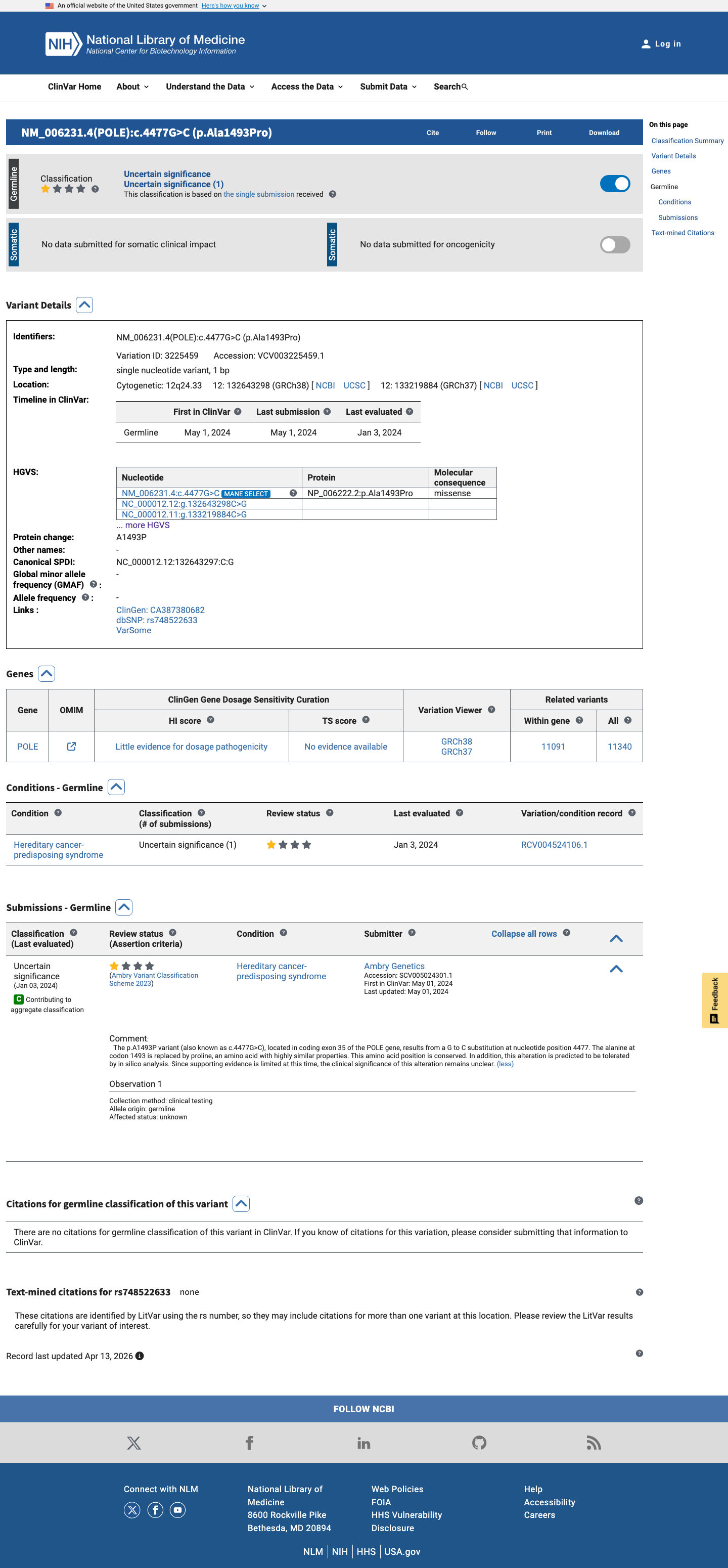
This variant has been reported in ClinVar as Uncertain significance (1 clinical laboratory). (ClinVarID = 3225459)
SpliceAI screenshot
In silico
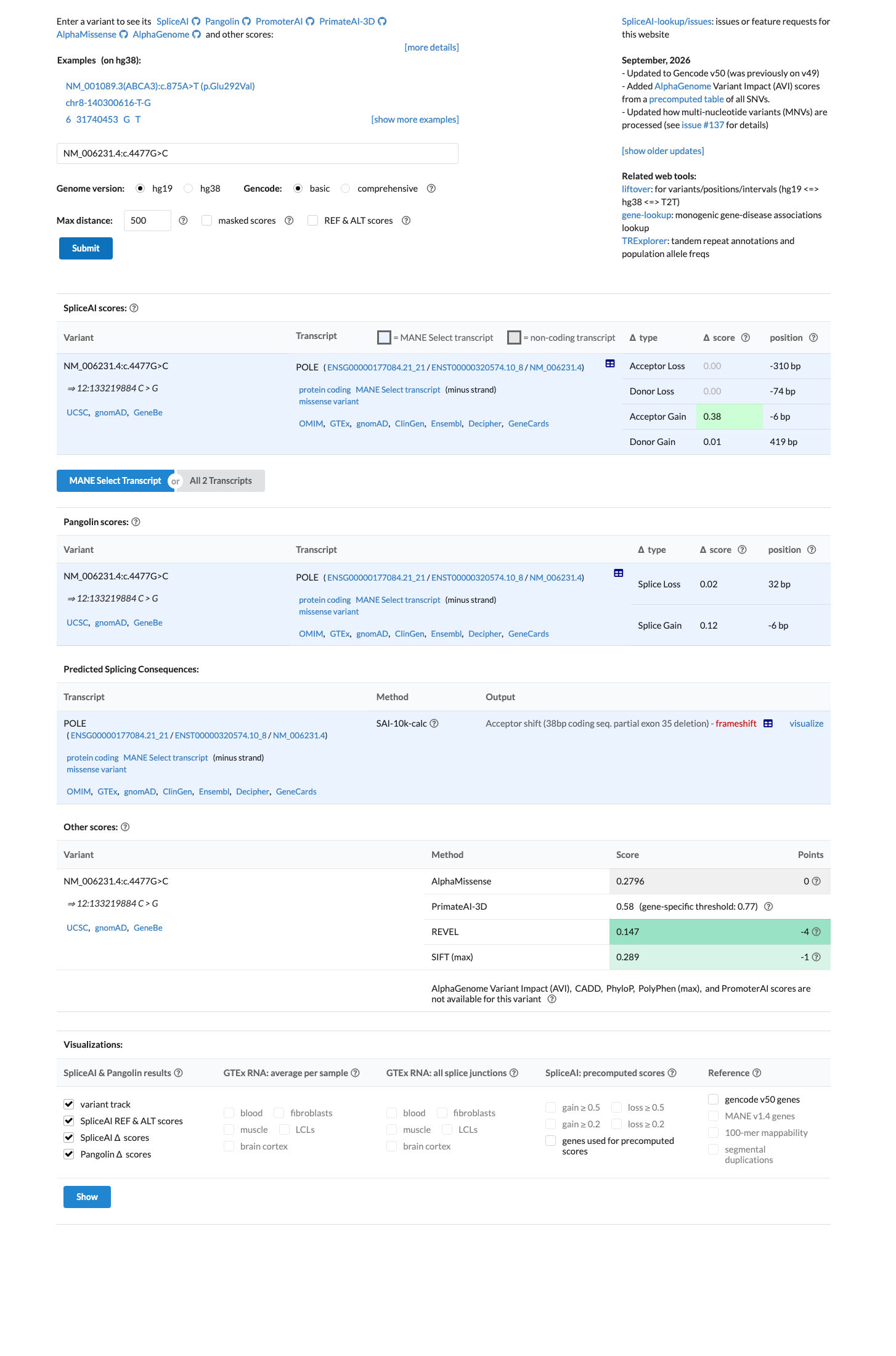
SpliceAI predicts possible splice impact for this variant (max delta score = 0.38). REVEL score = 0.147. BayesDel score = -0.538864.
Functional / OncoKB screenshot
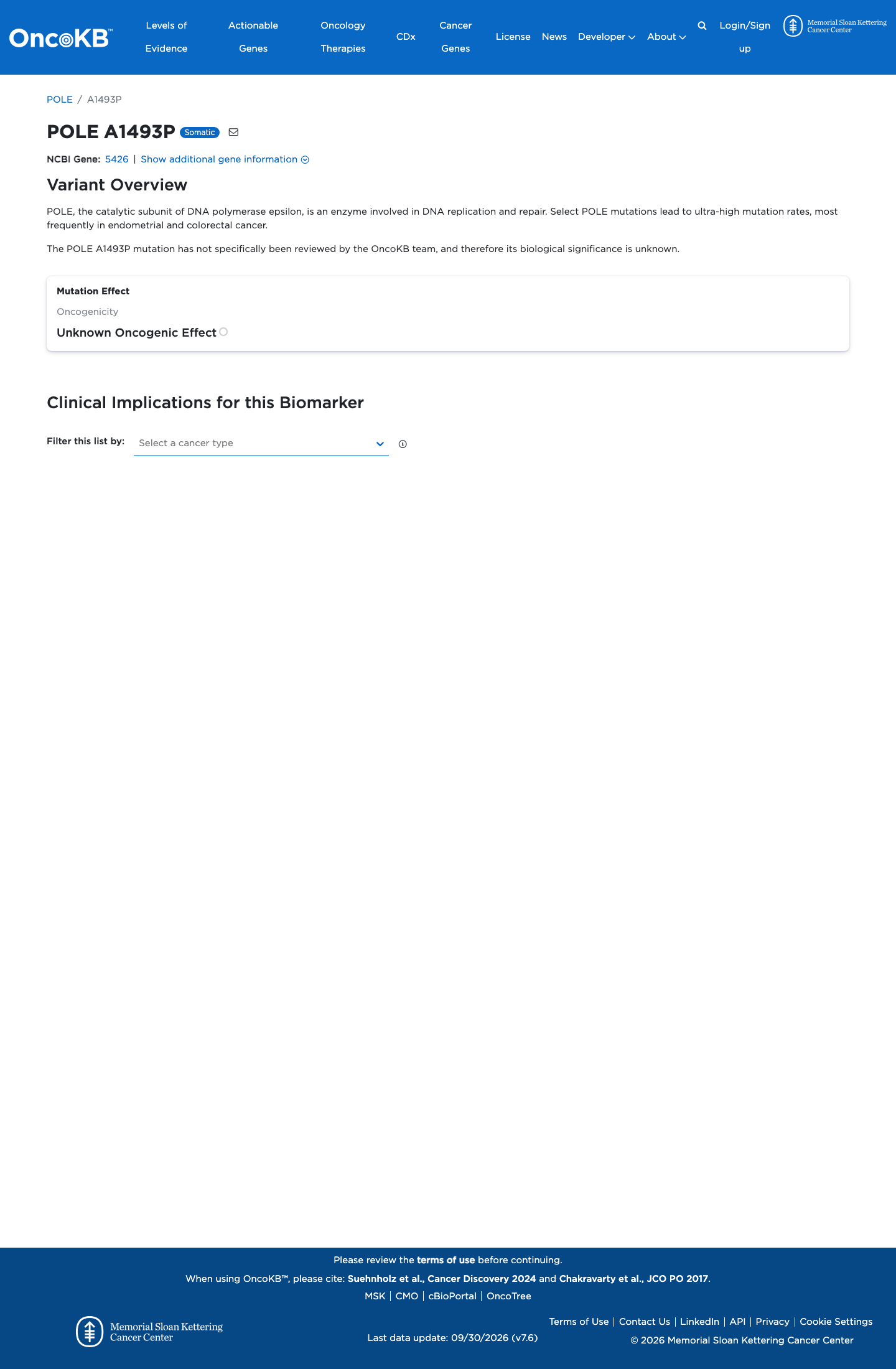
Functional Unknown Oncogenic Effect
OncoKB did not identify variant-specific reviewed functional evidence for this variant; gene-level curated context is available for reviewer follow-up. POLE, the catalytic subunit of DNA polymerase epsilon, is an enzyme involved in DNA replication and repair. Select POLE mutations lead to ultra-high m
OncoKB ↗
COSMIC screenshot
COSMIC
Cancer hotspots screenshot
Cancer hotspots
Somatic evidence Not in COSMIC / hotspots
COSMIC
This variant does not lie in a statistically significant hotspot. This variant has not previously been reported in somatic cancers (COSMIC).
Hotspots
This variant does not lie in a statistically significant hotspot.
Sources & reference links
8Sources
ClinVar
gnomAD v2.1
gnomAD v4.1
gnomAD-Canada
SpliceAI
OncoKB
COSMIC
Cancer hotspots
Triaged references · 1 PMID not cited in assessment
25394175 ↗ A practice guideline from the American College of Medical Genetics and Genomics and the National Society of Genetic Counselors: referral indications for cancer predisposition assessment. CLINVAR