Back
NM_006231.4:c.62+2T>G
p.? · POLE
León-Castillo et al. 2020 custom POLE framework · vleon-castillo-2020-custom-framework-v1
0%
complete
Final classification
Pathogenic
PVS1PM2PP3
POLE
c.62+2T>G
p.?
canonical_splice · exon 1i

POLE encodes the catalytic subunit of DNA polymerase epsilon, the enzyme that replicates the leading strand of DNA during cell division and participates in DNA repair. It contains a proofreading domain that corrects replication errors, keeping the accumulation of mutations in check. Germline mutations in POLE cause polyposis and predispose to colorectal cancer, and are also linked to a rare syndrome of facial dysmorphism, immunodeficiency, livedo, and short stature. Somatic mutations, particularly in the proofreading domain, occur in colorectal and endometrial cancers, where they drive an ultra-mutated tumor phenotype and are associated with better responses to immune checkpoint inhibitors.

This variant

Loss of normal POLE function is relevant to germline polyposis and colorectal-cancer predisposition because POLE provides DNA replication proofreading and repair.

Transcript
NM_006231.4
HGVS · transcript:coding
NM_006231.4:c.62+2T>G
GRCh38
chr12:132687252 A>C
GRCh37
chr12:133263838 A>C
Pathogenic: PVS1 (very strong), PP3 (moderate), and PM2 (supporting) satisfy the local POLE framework's PVS1 + moderate + supporting rule.
Classification rationale
PVS1PM2PP3 Pathogenic
POLE c.62+2T>G canonical_splice · exon 1i

Pathogenic: PVS1 very strong supports loss of normal POLE splicing at the canonical +2 donor site. Pathogenic: PP3 moderate is met by SpliceAI maximum delta 0.989. Pathogenic: PM2 supporting is met because the variant is absent from gnomAD v4.1 (0/1,487,734 alleles).

PVS1 + PM2 + PP3 Pathogenic
LYFE Sciences is an AI system, and it can make mistakes. Criteria may be applied incorrectly, sources may be misread, and a confident-looking classification can still be wrong. Double-check every criterion and its underlying evidence before relying on any call.
Gene diagram · NM_006231.4 · variants mapped to exon structure
POLE NM_006231.4
Fetching transcript structure from UCSC…
Applied criteria · 3 applied · 17 assessed
MetEvidence satisfies this criterion.
Not metEvaluated against available evidence; threshold not reached.
Not assessedApplies in principle, but no evidence was found to evaluate it.
N/ADoesn't apply to this variant type.
Applied · 3
Strength Supporting Moderate Strong Very strong
PVS1 very strong Pathogenic
Met at very strong: canonical splice-donor c.62+2T>G in the relevant POLE transcript has SpliceAI maximum delta 0.989 and no demonstrated NMD-escape downgrade.
The generic ClinGen SVI PVS1 framework (PMC6185798) applies to canonical splice consensus variants and requires consideration of transcript relevance, NMD escape, exon importance, and distal-region exceptions.NM_006231.4 is the MANE Select POLE transcript, and the variant is annotated as a canonical splice variant at c.62+2 with predicted protein consequence p.? and no alternative protein consequence supplied.The gene-level assessment supports POLE loss of function as a germline disease mechanism and marks the generic PVS1 gate eligible.
PM2 supporting Pathogenic
Met at supporting: AF 0 in gnomAD v4.1 (0/1,487,734 alleles) is below the <=0.0001 PM2 threshold.
The retrieved POLE-specific framework does not define PM2; generic ACMG/ClinGen-SVI fallback therefore applies.The supplied PM2 Supporting threshold is allele frequency <=0.0001 (ClinGen SVI recommendation, PMID:25741868).gnomAD v2.1 exomes report the variant as absent.
PP3 moderate Pathogenic
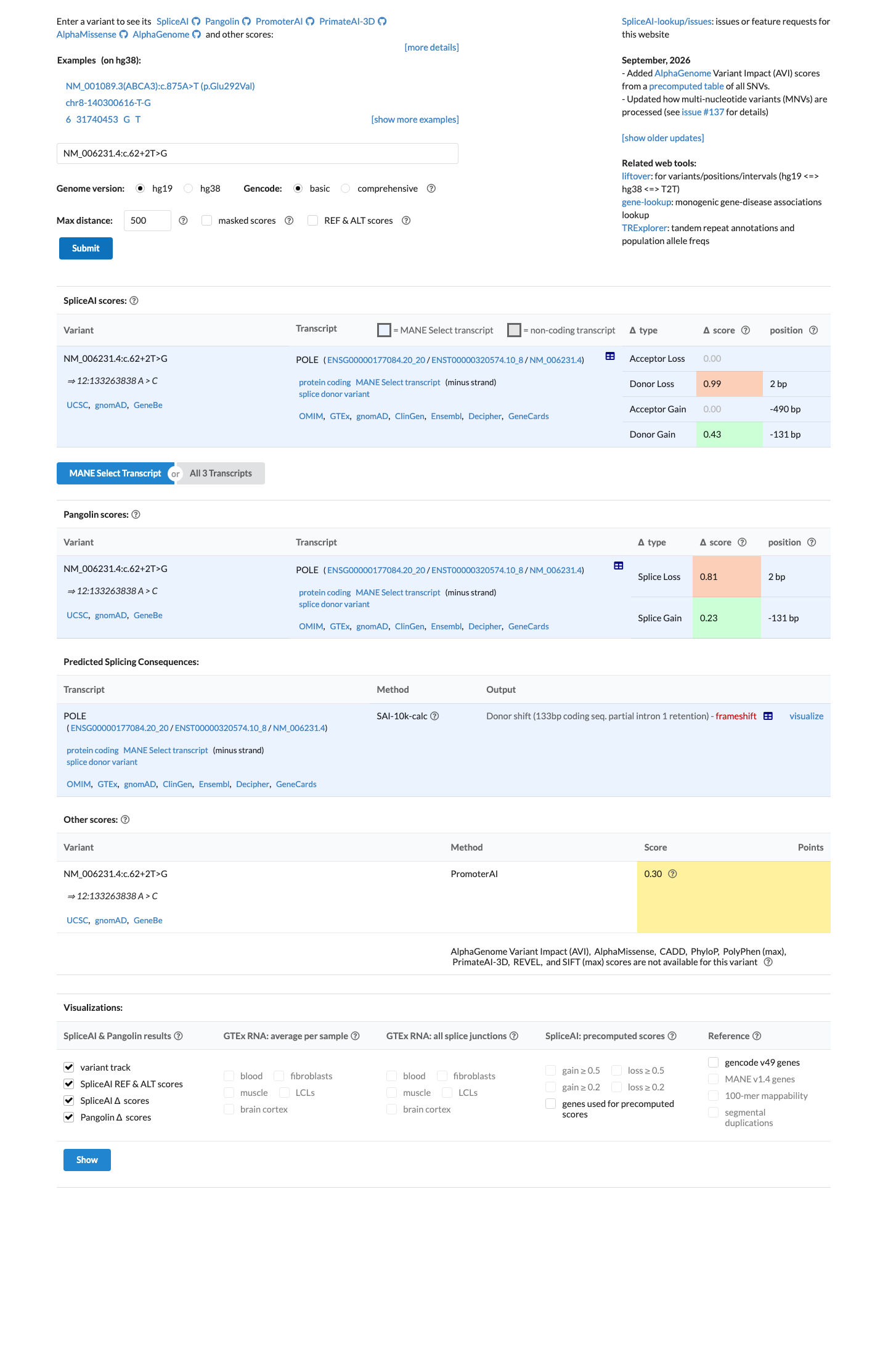
Met at moderate strength: SpliceAI maximum delta 0.989 exceeds the >=0.5 threshold for predicted splice impact.
The case normalization identifies NM_006231.4:c.62+2T>G as a canonical splice variant with predicted protein consequence NP_006222.2:p.?.SpliceAI reports DS_AG 0.0, DS_AL 0.0, DS_DG 0.426, and DS_DL 0.989; the maximum delta is therefore 0.989.The generic SpliceAI moderate PP3 threshold is >=0.5, from Jaganathan et al. 2019, Cell (PMID:30661751); 0.989 meets this threshold.
Assessed · not applied · 5 not met · 12 not assessed
Pathogenic
PS2 Not assessed: no parental genotypes, parentage confirmation, or testing methodology are documented to establish a de novo occurrence.
PS3 Not assessed: SpliceAI max delta 0.989 is computational and does not substitute for a validated variant-specific functional assay with appropriate controls.
PS4 Not met: the POLE PS4 rule requires an exact recurrent pathogenic missense variant with combined COSMIC/TCGA count >=10, but c.62+2T>G is absent and is splice-region.
PM3 Not assessed: no affected-proband observation or phased pathogenic variant in trans is documented for NM_006231.4:c.62+2T>G.
PM6 Not assessed: no published or clinical case evidence documents this variant as presumed de novo without parental testing.
PP1 Not assessed: no informative meioses or affected and unaffected relatives with genotype-phenotype segregation data are documented.
PP4 Not assessed: no patient phenotype or disease-specific clinical presentation is available to evaluate against a PP4 specificity rule.
PP5 Not assessed: ClinVar has no exact record or expert-panel Pathogenic/Likely pathogenic classification for c.62+2T>G.
Benign
BA1 Not met: gnomAD v4.1 total AF 0 (0/1,487,734 alleles), far below the >=0.05 BA1 threshold.
BS1 Not met: gnomAD v4.1 total AF 0 (0/1,487,734 alleles), below the >=0.01 BS1 threshold.
BS2 Not met: gnomAD v4.1 reports zero homozygotes and zero alleles, providing no healthy-population observation for BS2.
BS3 Not assessed: SpliceAI max delta 0.989 predicts splice impact and provides no validated evidence of preserved normal function for BS3.
BS4 Not assessed: no unaffected variant carriers or other informative non-segregation observations are documented.
BP2 Not assessed: no cis or trans observation with a pathogenic variant is documented for NM_006231.4:c.62+2T>G.
BP4 Not met: SpliceAI maximum delta 0.989 exceeds the <=0.1 threshold for BP4 supporting evidence.
BP5 Not assessed: no phenotype, alternative molecular diagnosis, or competing cause is available to evaluate BP5.
BP6 Not assessed: ClinVar has no exact record or expert-panel Benign/Likely benign classification for c.62+2T>G.
N/A · 8 PS1 · PM1 · PM4 · PM5 · PP2 · BP1 · BP3 · BP7
Research & evidence
Population frequency · supports pathogenic
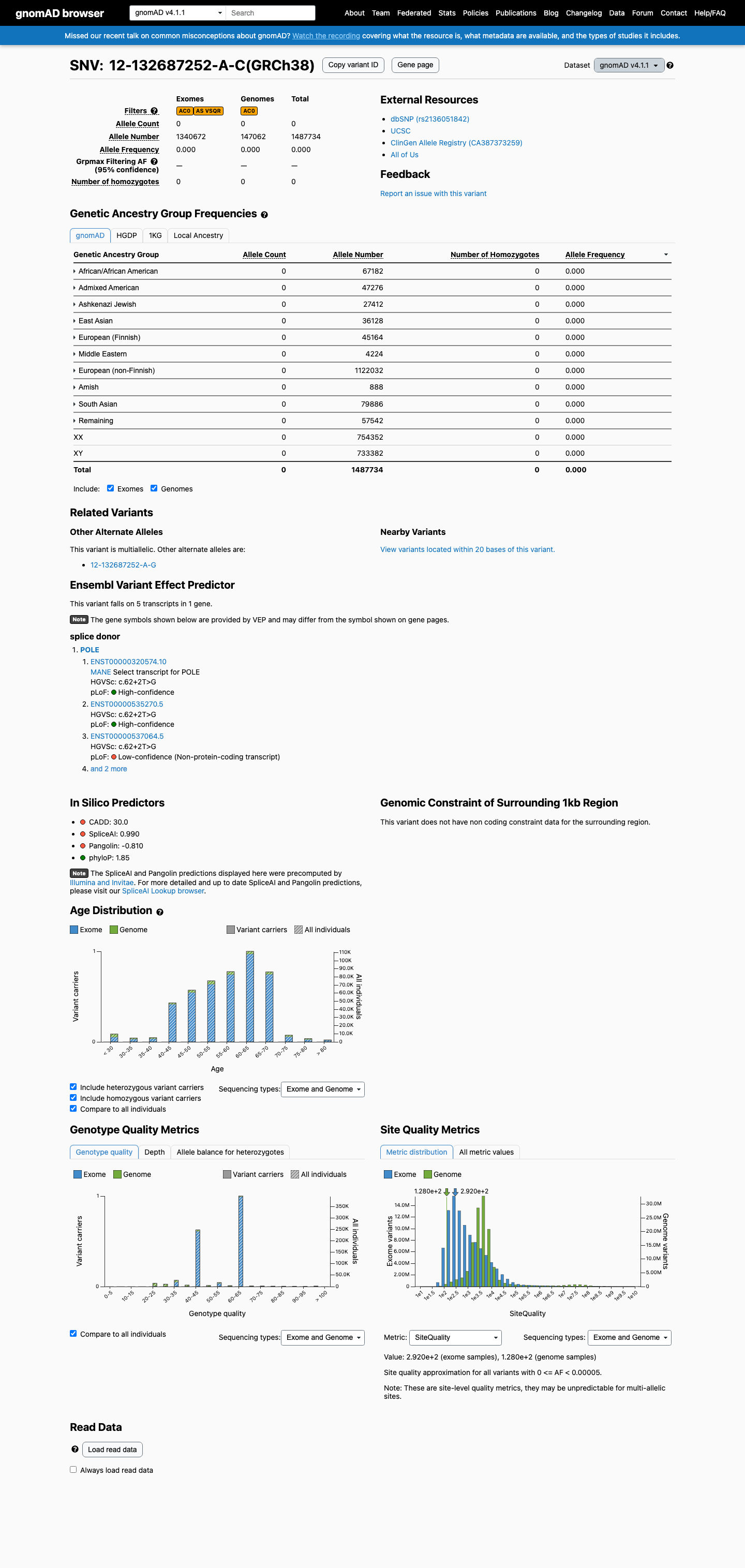
gnomAD v4.1 screenshot
gnomAD v4.1
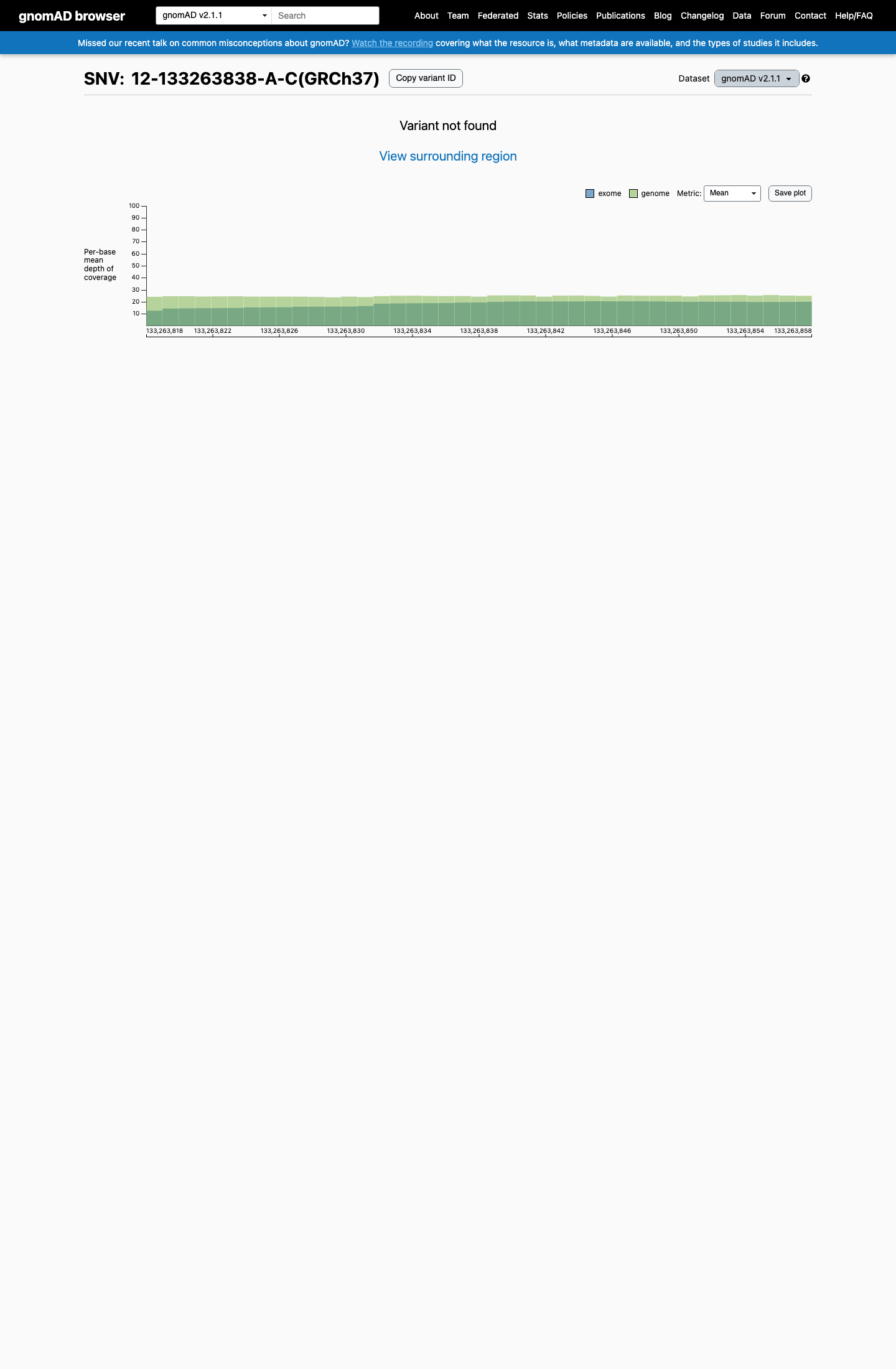
gnomAD v2.1 screenshot
gnomAD v2.1
v4.1
This variant is present in gnomAD v4.1 (AF= 0; MAF= 0.00000%, 0/1487734 alleles, homozygotes = 0) and has highest observed frequency in the African/African American population (AF= 0; MAF= 0.00000%, 0/67182 alleles, homozygotes = 0).
v2.1
Absent from gnomAD v2.1.
🇨🇦 CA
Absent from gnomAD-Canada v1.0.
Allele frequency by ancestry
three datasets · side by side
gnomAD v4.1
Absent · 0 / 1,487,734
0 hom
Not observed in any ancestry group.
+ 10 not observed (Remaining individuals, Admixed American, European (Finnish), Amish, East Asian, Middle Eastern, South Asian, Ashkenazi Jewish, African/African American, European (non-Finnish))
gnomAD v2.1
Absent · 0 / ?
0 hom
Not observed in any ancestry group.
gnomAD Canada 🇨🇦
Absent · 0 / ?
0 hom
Not observed in any ancestry group.
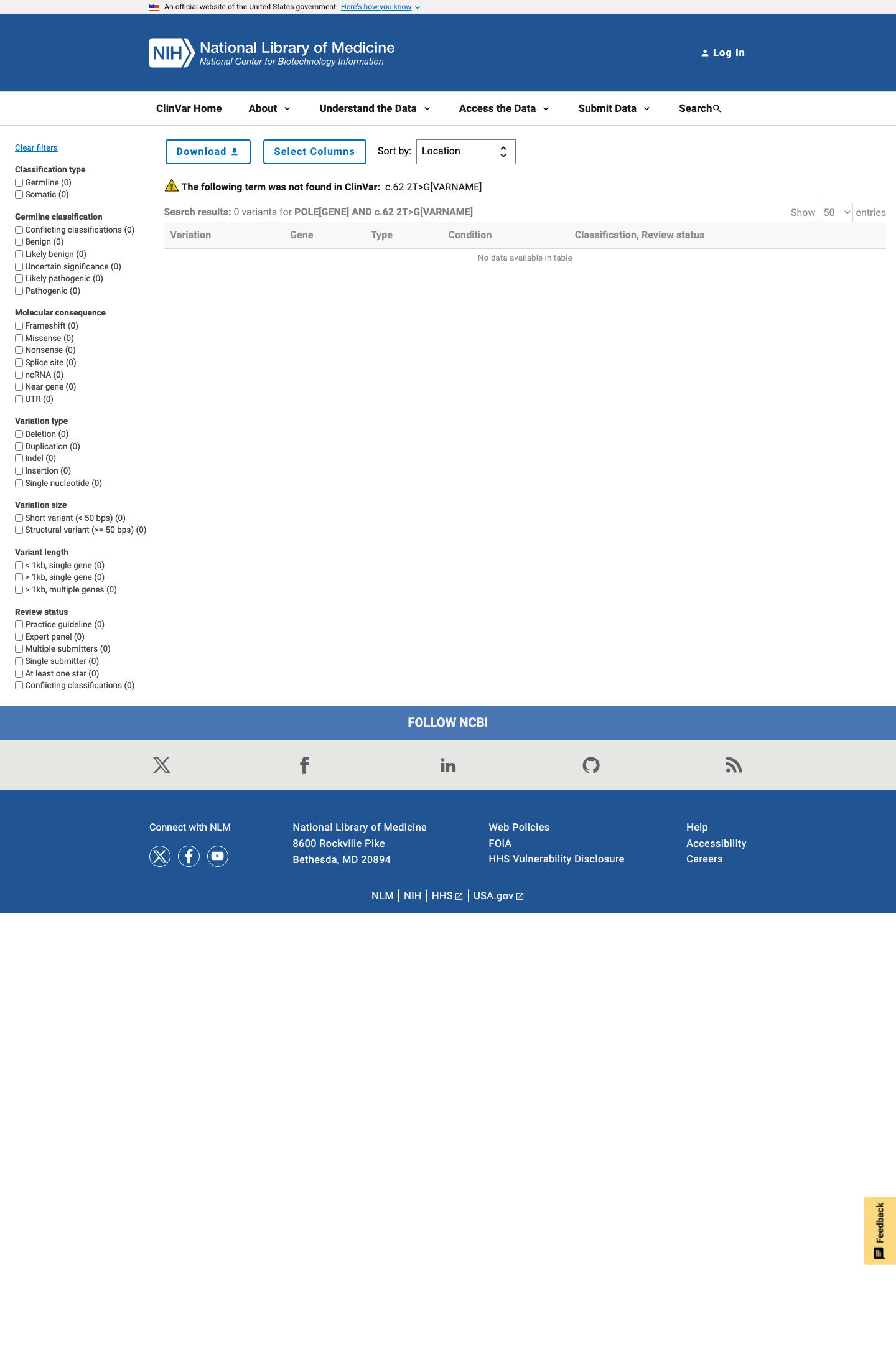
ClinVar screenshot
ClinVar
This variant is absent from ClinVar.
SpliceAI screenshot
In silico
SpliceAI predicts possible splice impact for this variant (max delta score = 0.99). BayesDel score = -0.279923.
Functional No data
No calibrated functional assay or RNA evidence was identified for this variant.
OncoKB ↗
COSMIC screenshot
COSMIC
Somatic evidence
COSMIC
This variant has not previously been reported in somatic cancers (COSMIC).
Hotspots
This variant does not lie in a statistically significant cancer hotspot.
COSMIC ↗
Sources & reference links
7Sources
ClinVar
gnomAD v2.1
gnomAD v4.1
gnomAD-Canada
SpliceAI
OncoKB
COSMIC