Back
NM_024675.4:c.1050_1051delinsTCT
p.Gln350HisfsTer11 · PALB2
0%
complete
Final classification
Pathogenic
PVS1PM2PM5
PALB2
c.1050_1051delinsTCT
p.Gln350HisfsTer11
frameshift · exon 4

PALB2 encodes a tumor suppressor protein that partners with BRCA2 (and also interacts with BRCA1) to repair double-stranded DNA breaks through the homologous recombination pathway. It acts as a scaffold that stabilizes BRCA2 in the cell nucleus and helps recruit DNA-repair machinery to sites of damage. Inherited mutations in PALB2 increase susceptibility to breast cancer, with smaller associated risks for ovarian, pancreatic, and prostate cancer and melanoma, and inheriting two mutated copies causes Fanconi anemia complementation group N. Rare somatic alterations in PALB2 are also found across various tumor types.

This variant

PALB2 is a tumor suppressor that supports BRCA1/BRCA2-mediated homologous-recombination repair, so inherited loss-of-function alleles increase susceptibility to breast cancer and other related cancers.

Transcript
NM_024675.4
HGVS · transcript:coding
NM_024675.4:c.1050_1051delinsTCT
GRCh38
chr16:23635495 TT>AGA
GRCh37
chr16:23646816 TT>AGA
Pathogenic: PVS1 (very strong), PM2 (supporting), and PM5 (supporting) satisfy Rule4 of the PALB2 VCEP Version 1.3 framework.
Classification rationale
PVS1PM2PM5 Pathogenic
PALB2 c.1050_1051delinsTCT frameshift · exon 4

Pathogenic: the early p.(Gln350HisfsTer11) frameshift supports PVS1 at very strong strength through PALB2 loss of function. Pathogenic: absence from gnomAD v2.1 and v4.1 meets PALB2's PM2 supporting rarity threshold. Pathogenic: the observed truncation ends at codon 360, upstream of the PALB2 VCEP PM5 cutoff at p.His1184.

PVS1 + PM2 + PM5 Pathogenic
LYFE Sciences is an AI system, and it can make mistakes. Criteria may be applied incorrectly, sources may be misread, and a confident-looking classification can still be wrong. Double-check every criterion and its underlying evidence before relying on any call.
Gene diagram · NM_024675.4 · variants mapped to exon structure
PALB2 NM_024675.4
Fetching transcript structure from UCSC…
Applied criteria · 3 applied · 6 assessed
MetEvidence satisfies this criterion.
Not metEvaluated against available evidence; threshold not reached.
Not assessedApplies in principle, but no evidence was found to evaluate it.
N/ADoesn't apply to this variant type.
Applied · 3
Strength Supporting Moderate Strong Very strong
PVS1 very strong Pathogenic
Met at very strong: frameshift p.(Q350Hfs*11) in exon 4 truncates PALB2 after 349 native residues and is far upstream of the extreme 3-prime region.
The PALB2 VCEP Version 1.3 PVS1 specification identifies null variants, including frameshift variants, as eligible for PVS1 when loss of function is an established disease mechanism.The case variant is NM_024675.4:c.1050_1051delinsTCT, predicted to produce p.(Gln350HisfsTer11) / p.(Q350Hfs*11), an early truncation rather than an extreme 3-prime truncation.The exact variant was reported as a heterozygous truncating frameshift in exon 4 and described as retaining only 349 residues of native PALB2 (PMID:18446436).
PM2 supporting Pathogenic
Met at supporting strength: the variant is absent from gnomAD v2.1 and v4.1, satisfying PALB2's ≤0.000333% PM2 threshold.
The PALB2 Version 1.3 specification defines PM2 supporting as frequency ≤1/300,000 (0.000333%) in the gnomAD subpopulation with the highest frequency, with an exception for one carrier confined to a single subpopulation.The variant is reported absent from gnomAD v2.1 and gnomAD v4.1, which is below the specified PM2 frequency threshold.
PM5 supporting Pathogenic
Met at supporting: the observed p.Gln350HisfsTer11 frameshift terminates at codon 360, upstream of the PALB2 VCEP PM5 cutoff p.His1184.
PALB2 VCEP v1.3 PM5_supporting applies to NMD-prone DNA truncating variants receiving PVS1 at Very Strong strength with premature termination codons upstream of p.His1184.The case variant is a frameshift, p.(Gln350HisfsTer11), placing the premature termination at codon 360, upstream of p.His1184.PMID:18446436 directly reports the same truncating frameshift as 1050_1051delAAinsTCT in a breast-cancer family.
Assessed · not applied · 3 not met · 3 not assessed
Pathogenic
PS4 Not met: the exact variant occurred in 1/360 cases versus 0/864 controls, with two-sided exact p=1.0 rather than the VCEP PS4 threshold of ≤.05.
PP1 Not assessed: one affected mother segregated the variant with the proband, but no required quantitative result was provided to compare with LOD ≥0.3 or LR ≥2:1.
Benign
BA1 Not met: the variant is absent from gnomAD v2.1 and v4.1, so no allele frequency exceeds PALB2's >0.1% BA1 threshold.
BS1 Not met: the variant is absent from gnomAD v2.1 and v4.1, so no allele frequency exceeds PALB2's >0.01% BS1 threshold.
BS2 Not assessed: no documented homozygote or unaffected-carrier observations are available to meet PALB2's BS2 point thresholds.
BS4 Not assessed: no non-segregation was reported, and no quantitative LOD or LR was provided to compare with the BS4 thresholds.
N/A · 19 PS1 · PS2 · PS3 · PM1 · PM3 · PM4 · PM6 · PP2 · PP3 · PP4 · PP5 · BS3 · BP1 · BP2 · BP3 · BP4 · BP5 · BP6 · BP7
Research & evidence
Population frequency · supports pathogenic
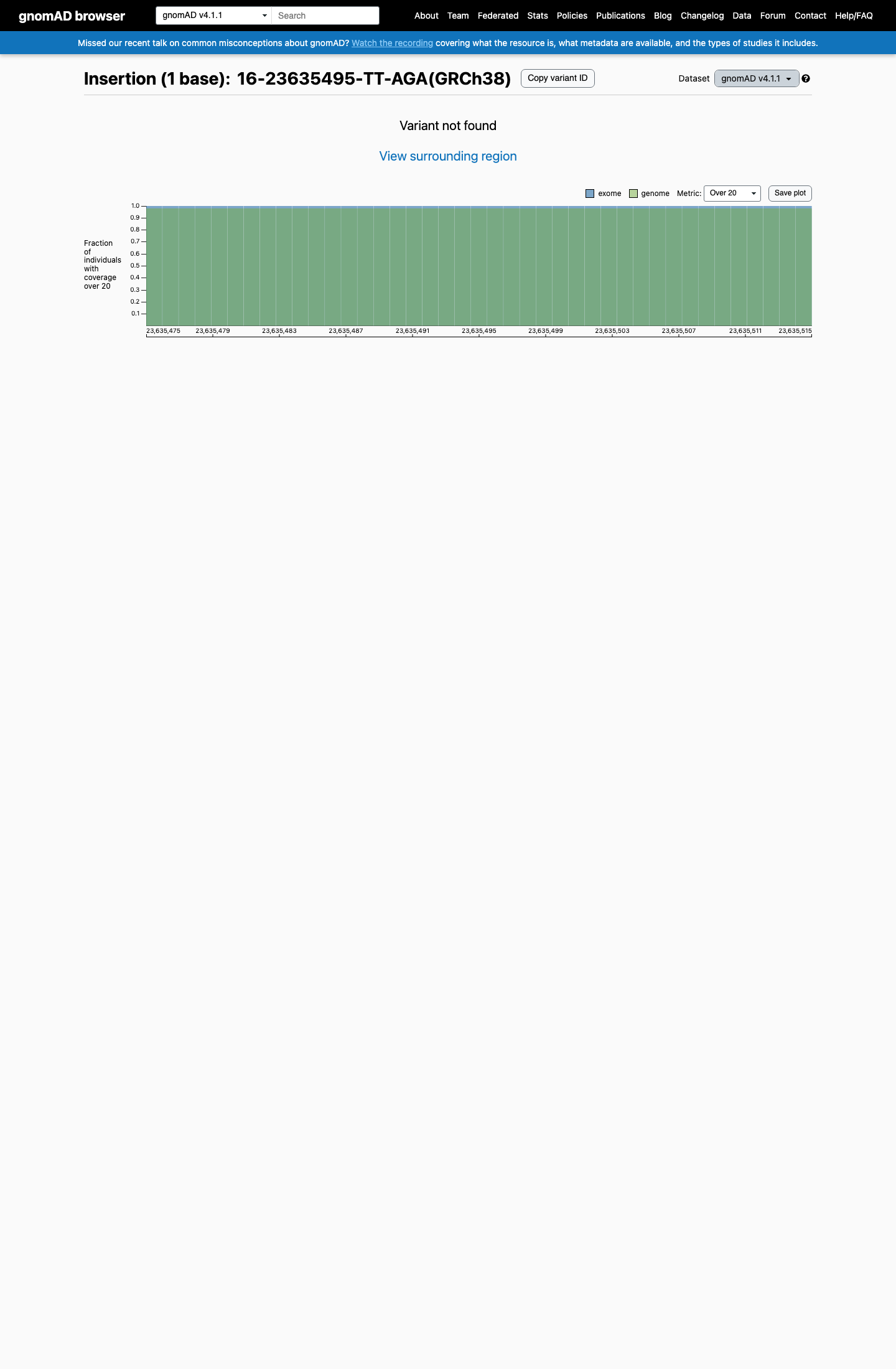
gnomAD v4.1 screenshot
gnomAD v4.1
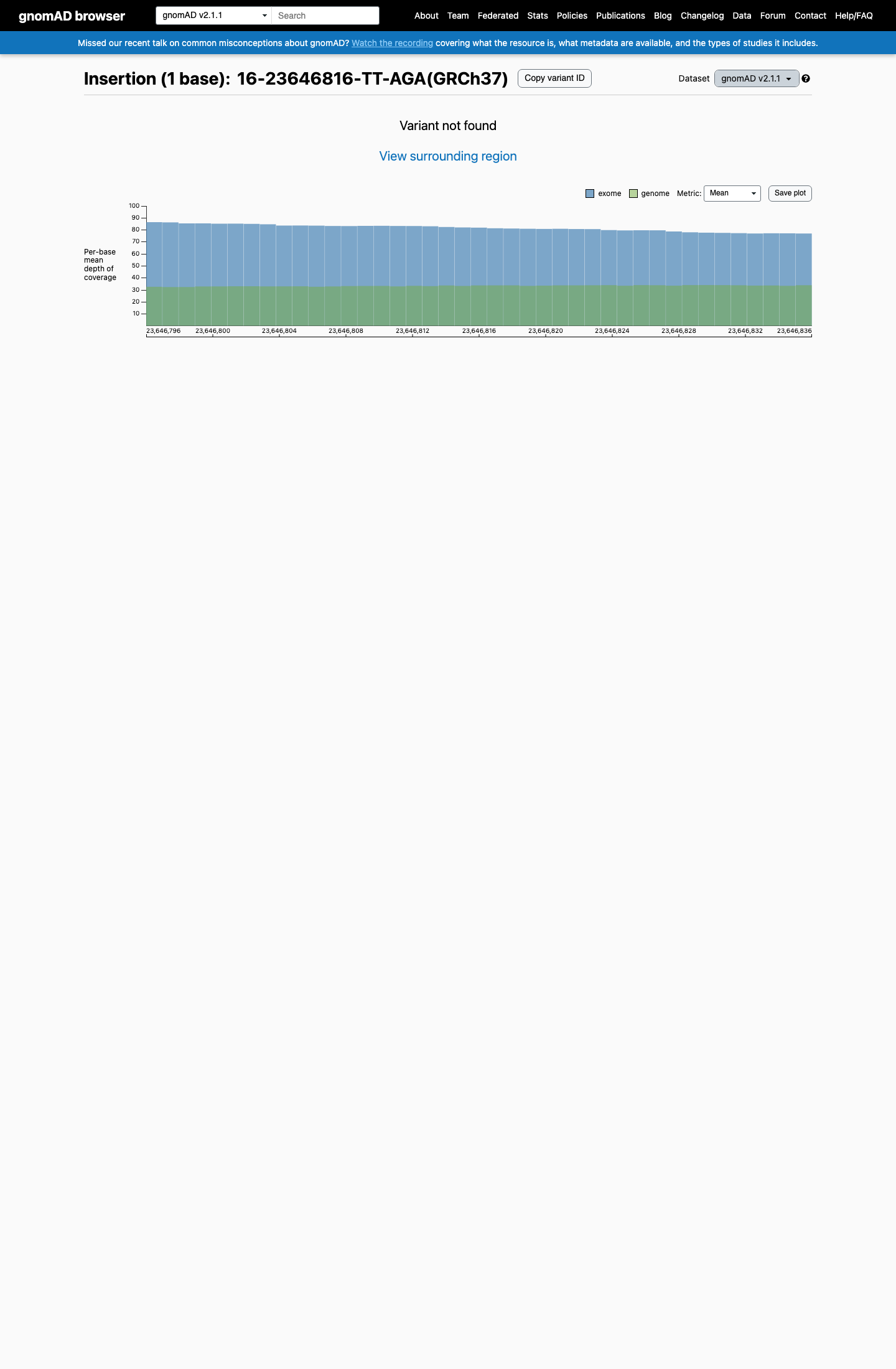
gnomAD v2.1 screenshot
gnomAD v2.1
v4.1
Absent from gnomAD v4.1.
v2.1
Absent from gnomAD v2.1.
🇨🇦 CA
Not available in gnomAD-Canada v1.0.
Allele frequency by ancestry
three datasets · side by side
gnomAD v4.1
Absent · 0 / ?
0 hom
Not observed in any ancestry group.
gnomAD v2.1
Absent · 0 / ?
0 hom
Not observed in any ancestry group.
gnomAD Canada 🇨🇦
Absent · 0 / ?
0 hom
Not observed in any ancestry group.
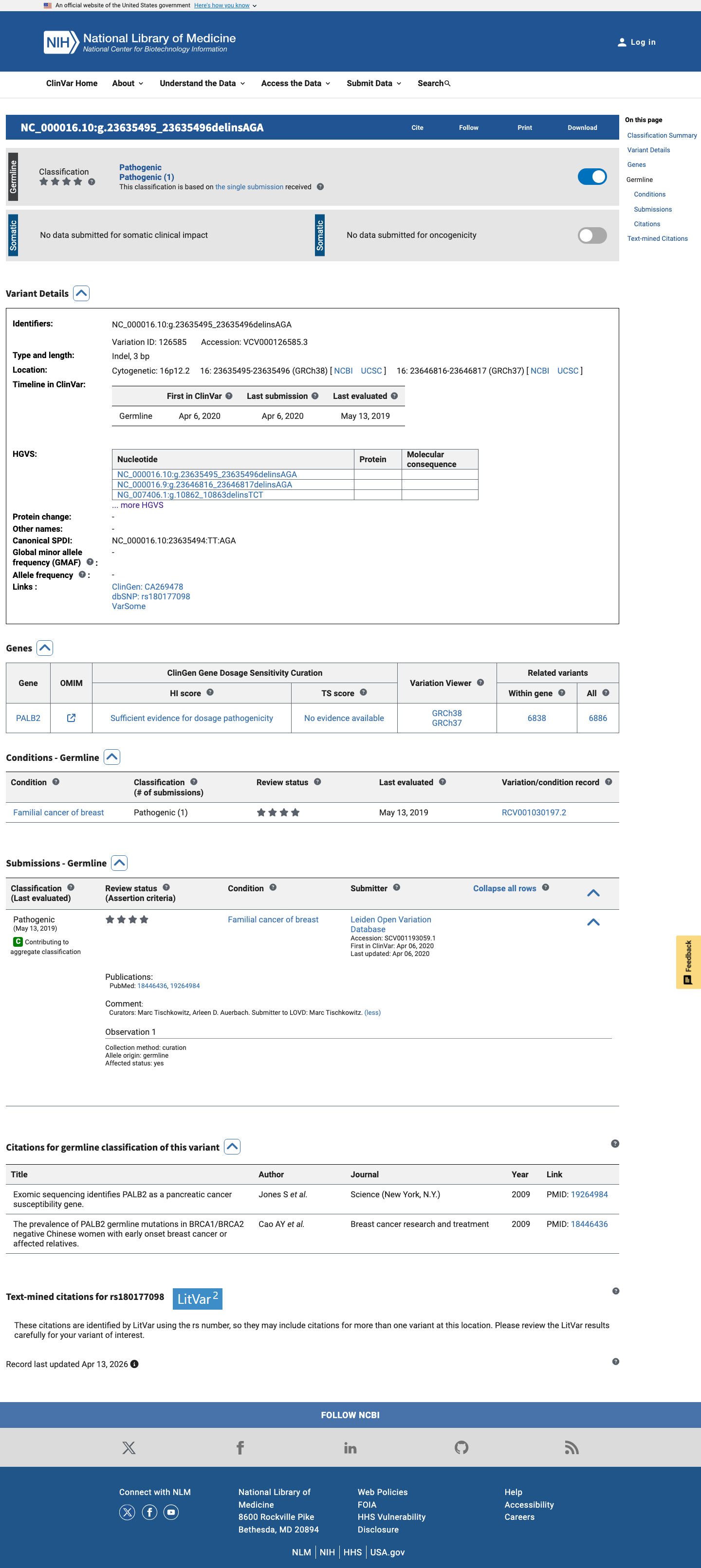
ClinVar screenshot
ClinVar
This variant has been reported in ClinVar but submission details could not be extracted. (ClinVarID = 126585)
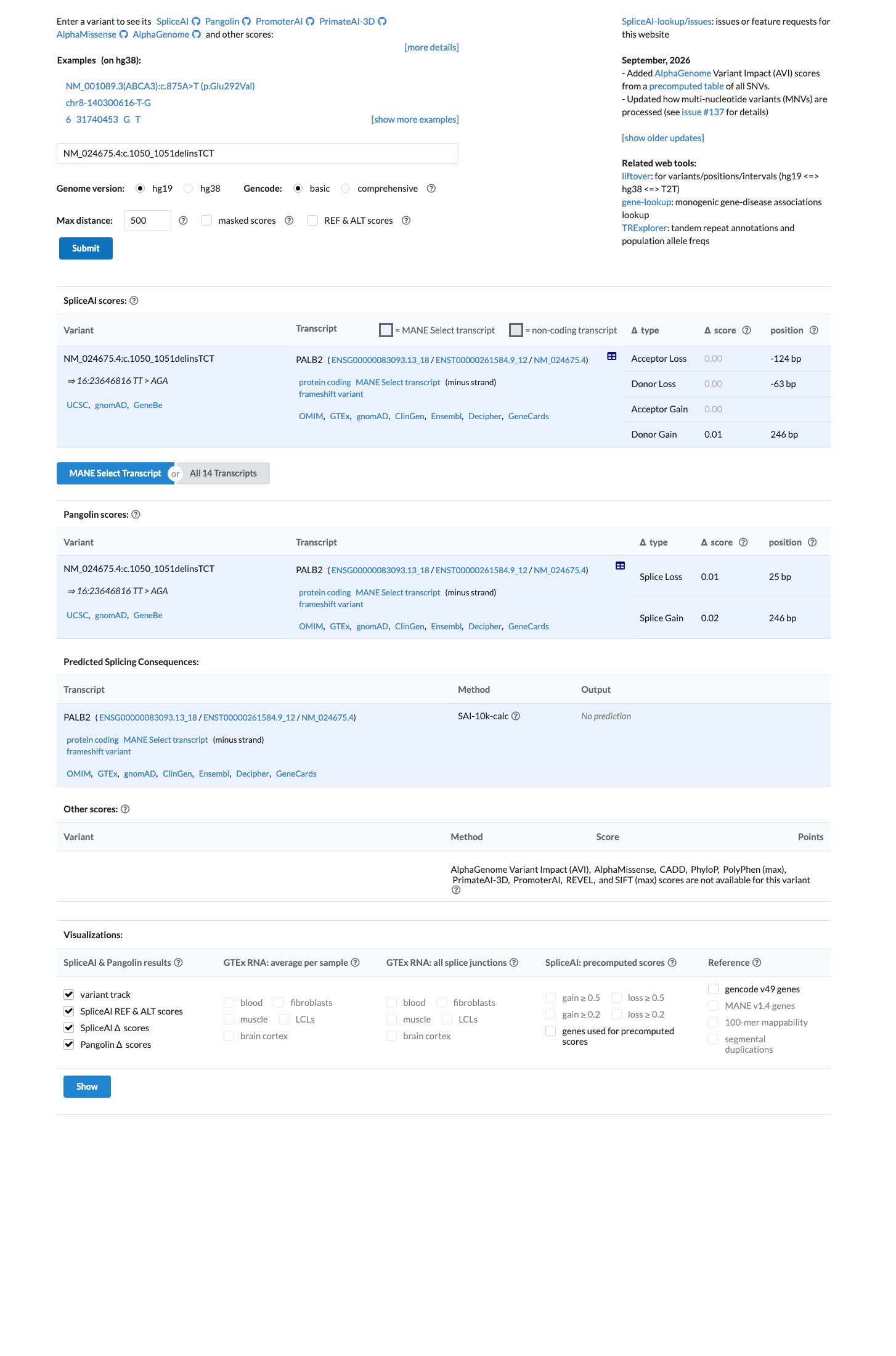
SpliceAI screenshot
In silico
SpliceAI predicts no significant splice impact for this variant (max delta score = 0.01).
Functional / OncoKB screenshot
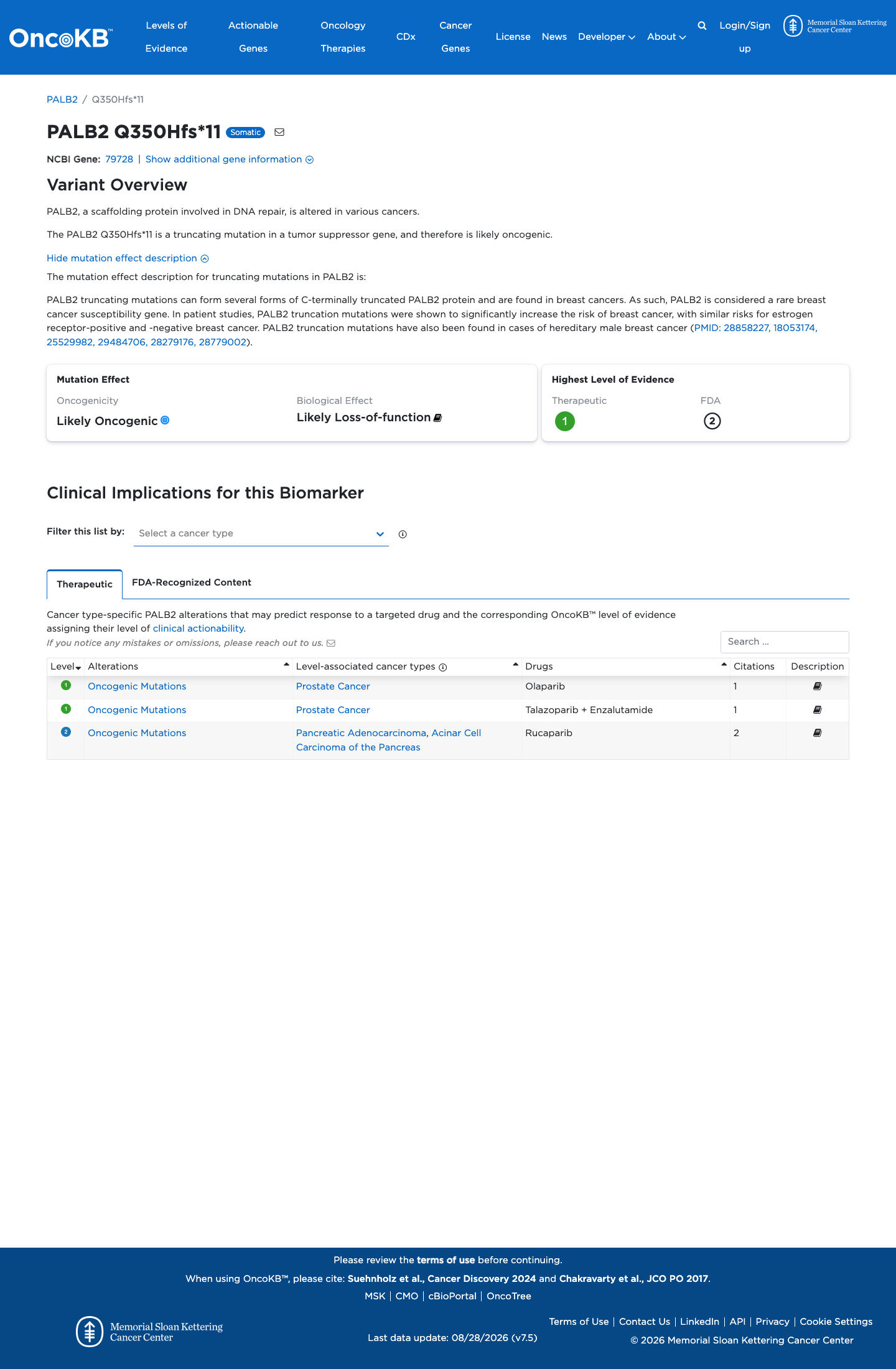
Functional Likely Oncogenic
OncoKB identified variant-specific curated literature and context relevant to functional review; biological-effect context: Likely Loss-of-function; curated oncogenicity label: Likely Oncogenic.
OncoKB ↗
COSMIC screenshot
COSMIC
Cancer hotspots screenshot
Cancer hotspots
Somatic evidence Not in COSMIC / hotspots
COSMIC
This variant does not lie in a statistically significant hotspot. This variant has not previously been reported in somatic cancers (COSMIC).
Hotspots
This variant does not lie in a statistically significant hotspot.
Literature · how each cited paper was used
1papers cited
Each card is an audit: what was searched, what was found, whether it names the variant, which criteria it fed, and why. 7 further PMIDs triaged but not cited — see Sources & references.
The prevalence of PALB2 germline mutations in BRCA1/BRCA2 negative Chinese women with early onset breast cancer or affected relatives.
Searched
c.1050_1051delinsTCT1050_1051delAAinsTCTNP_078951.2:p.(Q350Hfs*11)
Found
This paper explicitly reports the same PALB2 variant as 1050_1051delAAinsTCT, a heterozygous truncating frameshift in exon 4 that produces a Q350 frameshift/fusion protein retaining only 349 residues of native PALB2. It was identified in one of 360 BRCA1/BRCA2-negative Chinese women with early-onset or familial breast cancer and was absent in 864 unaffected controls.
Variant
✓ Names this variant — characterised directly
Applied to
PVS1 very strong
Direct report of the exact truncating frameshift variant in exon 4 and its resulting shortened PALB2 protein.
PM5 supporting
Documents the same variant as an observed truncating frameshift, relevant to the PALB2 VCEP truncation-based PM5 rule.
A frameshift mutation, 1050_1051delAAinsTCT, was detected in a family with breast cancer history, the genetic testing about the proband’s mother indicated that this mutation was inherited from the maternal side.
Location Results, Clinical features of mutation carriers; Discussion; Tables 1–3; Fig. 2  ·  Context PALB2 mutation screening by PCR-DHPLC followed by bidirectional Sanger sequencing in 360 BRCA1/BRCA2-negative Chinese women with early-onset or familial breast cancer; comparison with 864 unaffected controls and family-member testing.  ·  full text
Sources & reference links
9Sources
CSpec VCEP
ClinVar
gnomAD v2.1
gnomAD v4.1
gnomAD-Canada
SpliceAI
OncoKB
COSMIC
Cancer hotspots
Triaged references · 7 PMIDs not cited in assessment
18053174 ↗ Identification of a novel truncating PALB2 mutation and analysis of its contribution to early-onset breast cancer in French-Canadian women. ONCOKB
25529982 ↗ A novel PALB2 truncating mutation in an Italian family with male breast cancer. ONCOKB
28279176 ↗ PALB2 mutations in BRCA1/2-mutation negative breast and ovarian cancer patients from Poland. ONCOKB
28779002 ↗ Rare, protein-truncating variants in ATM, CHEK2 and PALB2, but not XRCC2, are associated with increased breast cancer risks. ONCOKB
28858227 ↗ The Role of PALB2 in the DNA Damage Response and Cancer Predisposition. ONCOKB
19264984 ↗ Exomic sequencing identifies PALB2 as a pancreatic cancer susceptibility gene. CLINVAR
15604628 ↗ Genetic cancer risk assessment and counseling: recommendations of the national society of genetic counselors. CLINVAR